The year was 1947. In the midst of a turbulent era in Chinese history, the ancient city of Ankang, situated along the Han River in southern Shaanxi, was captured in a light never seen before: living, breathing color.
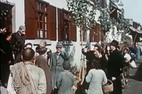
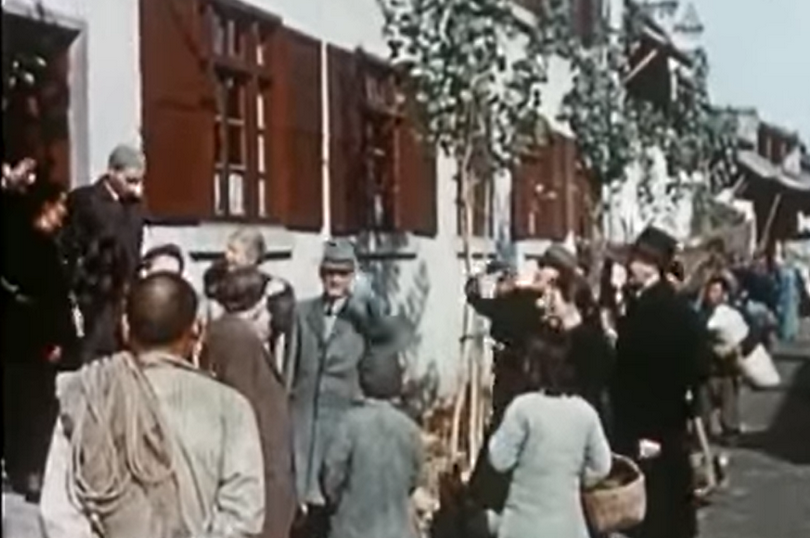
The footage, known today as "Color Old Ankang (1947)," is regarded as the first color documentary filmed in China. Shot by Norwegian missionary Carl Mortensen using a Kodak 16mm camera, the film offers a rare and vibrant window into the daily lives, religious activities, and social customs of Ankang just two years before the founding of the People's Republic of China.
In 1947, Ankang was a pivotal trade and transportation hub on the upper reaches of the Han River. While much of the nation was embroiled in the Civil War, Mortensen's lens captured a city that appeared bustling and relatively stable. Known historically as "Jin Zhou" (Golden Prefecture), the city was a melting pot of mountain produce and river commerce.
The documentary opens with shots of the natural landscape—the rolling Qinling Mountains and the emerald waters of the Han River, dotted with traditional wooden merchant boats. But the camera quickly moves to the heartbeat of the city: the people.
The footage reveals a vibrant market economy. The streets are teeming with life, described in the film's narration as a place where "countless people come from outside to buy and sell, making Ankang lively every single day." Viewers can see farmers shouldering heavy loads of vegetables and crops, women spinning thread in the sunlight, and artisans crafting traditional oil-paper umbrellas.
There are intimate, human moments that transcend time: a family making incense, a tailor working next to the church, and a "noodle master" in Hengkou town deftly handling long noodles, a scene a young foreign boy—the film's narrator in his youth—is seen curiously reaching out to touch. The film also captures unique local customs, such as a young bride wearing glasses sitting in a sedan chair, surrounded by a procession carrying her dowry, and the rural tranquility of grinding flour using both ox-driven and hand-cranked stone mills.
The film is not just a travelogue; it is a historical record of the Evangelical Lutheran Free Church of Norway (Frikirken) in China.
The mission's history in the region dates back to roughly 1917, when the pioneer missionary Rev. O.A. Sommernes (known in Chinese as Xia Minghua) selected southern Shaanxi as a center for evangelism due to its lack of medical and educational resources. Rev. Xia founded the "Lutheran Hospital" (Xinyi Hospital)—the first Western medicine hospital in Ankang's history—and established schools to serve the local population.
By 1928, Rev. Johan Arndt Johansen (known in Chinese as You Hansen) arrived to assist Rev. Xia. The film captures the fruits of their decades of labor. It shows the "Gospel Church" in neighboring Hanyin County and the church in Ankang city, built in 1933 by Johansen. Notably, the latter features a distinctively Chinese-style pagoda tower, reflecting Johansen's vision that a church in China should harmonize with local aesthetics.
The camera also takes viewers inside the church's social work: the bustling church clinic on Little North Street, staffed by Norwegian and Chinese doctors and nurses, including Johnsen's wife.
In one poignant sequence, the mission holds a welcome party for Mortensen, the visiting Mission Board Chairman. Norwegian missionaries and Chinese co-workers sit together, sharing meals and laughter.
Central to the preservation of this history is the Johansen family. Rev. Johan Arndt Johansen's son, Johan Tidemann Johansen (known in Chinese as You Yuehan), was just two years old when he returned to war-torn Ankang with his parents in 1940. He spent ten years of his childhood in the city, speaking the local dialect and playing with local children.
I never felt like a foreigner, Johan recalled of his childhood. "I loved eating steamed noodles and 'Kangkang' buns by the street, and skipping stones on the Han River."
When the family returned to Norway, his father built a house named "Ankang," ensuring their Chinese home remained part of their identity. Decades later, Johan—who followed in his father's footsteps to become a pastor and the general secretary of the Mission Board—connected with Carl Mortensen's granddaughter. He obtained a copy of the 1947 film.
Since 1985, serving in the leadership role, Johan has led numerous delegations back to Shaanxi to witness the region's social progress and the development of the church.
In October 2013, Johan brought the digitized footage back to Ankang, donating it to the Ankang Museum.
In recognition of his enduring friendship and contribution to preserving local history, the Ankang Municipal Government named him an "Honorary Citizen" in 2018.
Since its release to the public, "Color Old Ankang" has garnered amazement from Chinese netizens. On platforms like Douban, viewers have expressed shock at seeing the "spirited smiles" of ordinary people from the pre-liberation era.
"The historical and humanistic value is incredibly high," one netizen commented. "It is hard to imagine seeing such prosperous, peaceful scenes of ordinary life during the Civil War era. The smiles on their faces are bright."