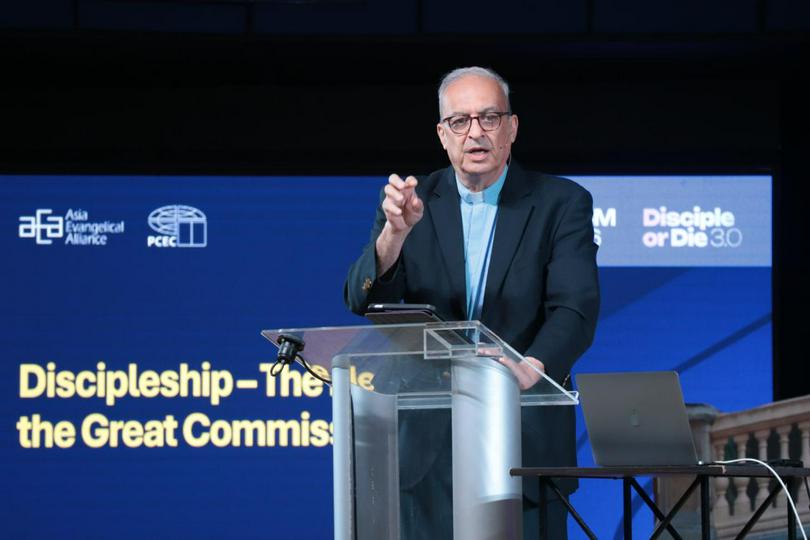
Rev. Adv. Botrus Mansour, an Arab Christian and Baptist elder from Nazareth, Israel, was appointed Secretary General and CEO of the World Evangelical Alliance (WEA) in August 2025 and formally installed in the role at the WEA General Assembly in Seoul in October 2025. Beyond his work at the WEA, Mansour trained as a lawyer and oversees operations at Nazareth Baptist School.
Founded in London in 1846, the WEA is one of the broadest global evangelical networks, representing more than 650 million evangelicals through national and regional alliances, affiliated organizations, and church networks in more than 160 countries.
In April 2008, Geoff Tunnicliffe, then head of the WEA, visited China and met in Beijing and Shanghai with leaders of the China Christian Council and the Three-Self Patriotic Movement, commonly referred to together as CCC&TSPM, as well as relevant government officials. The visit became one of the early publicly documented contacts between the WEA and churches in the Chinese mainland.
The following year, in November 2009, a 24-member WEA delegation made a significant visit to China, meeting leaders of the CCC&TSPM, as well as local officials and church leaders, in an effort to deepen communication between Christians in China and the wider evangelical community.
Bible ministry became another point of public connection: in 2011, Tunnicliffe addressed the opening of the Chinese Church Bible Ministry Exhibition in Washington, D.C. — an exhibition organized by the CCC&TSPM that showcased the history of Bible translation, publishing, and church life in China.
The following year, in May 2012, WEA leaders returned to China for a visit, which the alliance itself framed as part of "building bridges of understanding." Tunnicliffe and WEA Global Ambassador Brian Stiller met in Beijing with Wang Zuo'an, then director of the State Administration for Religious Affairs, along with leaders of the CCC&TSPM— a visit that, in WEA's own account, gave it a clearer public language for its role as a connector between Christians in China and the global evangelical family.
Contact continued in the years that followed, including a 2017 visit by then-Secretary General Bishop Efraim Tendero and a 2020 donation — facilitated by the WEA — of 70,000 face masks from the Anhui TSPM to churches in Zimbabwe during the COVID-19 pandemic.
A new chapter opened in 2023 with the launch of the World Chinese Christianity Alliance (WCA). Based at the Enarche Institute in Singapore, the WCA was introduced by the WEA as a global platform serving ethnic Chinese Christians through resource sharing, academic exchange, training, publishing, and international connection — WEA's first affiliated alliance organized around ethnicity rather than national borders. It gives the WEA a framework for engaging Chinese Christians globally, including diaspora communities and Chinese-speaking churches across different regions.
From July 20 to 24, 2024, a delegation from the WEA and the WCA visited China — the WEA's first publicly reported visit to the country since 2017. According to the WEA, the visit was organized by Rev. Ezekiel Tan, the WEA's Special Envoy to China and Chinese territories, to learn about the state of Christianity in China and to rekindle ties with the CCC&TSPM.
Against this background, Mansour said in the interview that although he has not yet visited China, he hopes WEA can continue to build a relationship and trust with Christians in China. He also reflected on the role of Chinese Christians in the global evangelical family and the significance of the WCA within the WEA network.
The interview was conducted on the second day of the Asia Conference on Church & Mission (ACCM) 2026, after Mansour had delivered the conference's opening keynote address. Some of the questions that followed referred to themes he had raised in that message.
This interview has been edited for clarity.
China Christian Daily: Since assuming the role of the secretary general of the World Evangelical Alliance, what has been your biggest impression and your reflection so far?
Botrus Mansour: My impression while traveling has been that the Lord is doing great things around the world. The Spirit of the Lord is moving in different places, in different ways. Despite the challenges and difficulties, there are lovely people who love the Lord, and things are moving well.
China Christian Daily: You mentioned that your schedule has been crazy. As you travel and meet evangelical leaders around the world, what are you learning about the current state of the global evangelical family?
Botrus Mansour: In general, I think it's doing well. There are challenges in some countries, but overall, there are good leaders, many new believers, and emerging leaders stepping up to do God's work. So my impression is quite a good one.
China Christian Daily: You are the first Arab Christian to lead the World Evangelical Alliance, and you come from Nazareth, with a unique Arab, Israeli, and Palestinian Christian background. How has your personal story shaped your understanding of Christian unity?
Botrus Mansour: The fact that I am a minority within a minority, in a country that has experienced conflict for many years, has probably helped me stay balanced — I'm not surprised when I see violence, conflict, or strife among people, whether inside the church or outside it. I've seen it all. I've lived through several wars, and even now, in the Middle East — in Israel itself — just 15 minutes before I left home for this trip, there was a siren, and we had to run to the shelter. Afterward, I took my bag without knowing whether the airport would even be open or whether flights would be running. When you've seen so much, you become a little numb to things happening elsewhere. That doesn't mean you're not sensitive — but you're no longer surprised by it.
China Christian Daily: In your remarks, you also mentioned challenges facing the church today, including technology and war. From your perspective, what are the greatest challenges facing Christian unity in today's global church?
Botrus Mansour: I think the greatest challenge to unity is that, because of different cultures and a mentality of individualism — "I can do it myself," "I don't need anybody else to help me" — people just go their own way. They're not willing to collaborate, unite, or come together in fellowship with other people. I think sometimes it's a little bit of selfishness: "I am the center, I have my own empire, I have my own church, I have my own denomination, and I don't want unity, closeness, or any kind of fellowship with anybody else." So I do my own thing. And that creates a bit of disunity. I think that's the main thing. There are other things, but I think this one drew my attention.
China Christian Daily: How do you see the place of Chinese Christians within the global evangelical family today?
Botrus Mansour: China is a great nation — known for being hard-working, serious, good people, with a major impact on the countries around it. I think Christians in China have an important role to play as well. Just as China as a country has blessed the world through its strong economy and its influence in different countries, I believe Chinese Christians — with their large numbers and the seriousness of their faith — can also be a blessing to other countries, in Asia and beyond. I think there's an important place — a major place, even a central place — for Chinese Christians at the table of the global church, where they can contribute to the betterment of the world, the church, and communities everywhere.
China Christian Daily: Do you have any personal interaction with China?
Botrus Mansour: Unfortunately, I've never been to China. But I've met Chinese people while traveling in the West and elsewhere. They're always kind, serious, faithful in their relationships, and very friendly. But not more than that, unfortunately. I'd love to have a closer relationship with the Chinese.
China Christian Daily: In 2024, a delegation from the WEA visited China and met with the leaders of the CCC. Looking ahead, does the WEA hope to continue deepening its engagement with Christians in China?
Botrus Mansour: No question. Yes, of course, of course. I'd love that very much. I don't know exactly what happened and why — I believe WEA's previous leader had to step down for health reasons, which may have slowed the relationship, and there wasn't a strong follow-up on it. But I'd love to move quickly: to make another visit, to establish relationships, and to strengthen relationships with the Chinese authorities and with the Chinese church in general. Yes, I think it's very important. This isn't just another country to us. As the WEA, we have 164 alliances around the world, almost covering the whole world — but China holds a central, important place that I'd love to give attention to: visiting, building cooperation, building relationships, building trust. It starts with trust. Christian fellowship isn't a mechanical thing — it's not just "let's come together." Let's build trust, let's build a friendship, and as a result, we can move the relationship forward to a new level.
China Christian Daily: The WCA is the first WEA-affiliated alliance based on ethnicity rather than national borders. In your view, what is the importance of such an alliance within the WEA family?
Botrus Mansour: Because it's ethnic rather than tied to a single nation, it has a wide-reaching impact for Chinese people everywhere. That's significant — and as I said before, because China is such an important country, its people carry influence wherever they live. So this ethnic, affiliated alliance has already had a good impact, and we're happy to have it within the WEA. We hope the relationship continues to grow even stronger.
China Christian Daily: What role do you hope the WCA can play in connecting Chinese churches around the world, and also in helping the global church better understand the Christians in China?
Botrus Mansour: I think each member living around the world is like an ambassador. Through their openness, their friendship, their Christian faith, and the way they live it out, they help people in other nations get to know Chinese Christians better. And as a result of this new knowledge — of getting to know them better as ambassadors — it helps promote the relationship and helps China as a whole, and Chinese Christians in particular, to be known much more and appreciated much more.
China Christian Daily: In your speech, you also mentioned the Pope's recent encyclical, Magnifica humanitas. From an evangelical perspective, how should churches respond to the ethical and pastoral challenges raised by AI?
Botrus Mansour: I was actually reading it on the plane on my way here — I spent a few hours with it. It's a long, well-written document by the Pope and those who helped him write it. I think it's an excellent start in trying to address artificial intelligence and its impact on our world.
AI is moving us into a new era, but the question is: are we simply opening the door to a machine that could overcome us as human beings? It raises some ethical questions. If we keep it without control, or don't bring the ethical questions of our Christian faith to AI, we risk going down a path that's bad for humanity — and that's also what the Pope is saying. I think we should study what he's written, along with other philosophers.
I've already spoken with our team at the WEA, and we're forming a group of theologians, thinkers, and evangelical philosophers to respond to these questions, taking the encyclical into account, but also working ahead so that we're prepared for the future. There will need to be boundaries around how people use AI. We want to engage with it responsibly — without contradicting our faith, and without leaving it unchecked simply because we want things to move faster and more complicated, at the cost of our humanity.
China Christian Daily: As you look at the future of the global church, what gives you the greatest concern and what gives you the greatest hope?
Botrus Mansour: Let's start with hope. Jesus is our hope — the one we look to. Without Him, there's no hope in the world at all. Because His Spirit is in the world and in His church, I see hope in churches and in believers — beautiful believers who love the Lord from different cultures, who simply love Him and want to serve Him and glorify His name. That's what gives me hope.
Concern... I think of fragmentation. Let me think a bit more, though, because there are a few things, and none of them is the absolute largest. Maybe the greatest concern is the mingling of nationalism with the Christian faith in different countries. Christians are so immersed in the nationalistic, patriotic life of their countries that sometimes they mingle the two together. As a result, they become hostile toward another country or overly nationalistic, and that isn't what the gospel teaches. We read in the gospels, in the Sermon on the Mount, about love, forgiveness, and acceptance. But in some places — not everywhere, but it's there — the church grows too close to the government or the state, mingling faith into the nationalistic things of a certain country. That corrupts the gospel in several countries, and it's something I'm concerned about.
China Christian Daily: People often talk about polarization, the politicization of religion, and the religionization of politics. Is this the same dynamic you're describing?
Botrus Mansour: Yes — and this kind of mingling with nationalism or government causes fragmentation. Because I take my government's position, and because they're opposed to another country, I sort of put a religious or faith-based cover over political views I already hold. I start saying, "I hate that country, I hate what they're doing, because of my faith" — but that isn't true. The Bible never tells you to hate another country, and Jesus never tells you to hate another country either. Mixing all of this isn't good — I think faith and national allegiance should be kept separate. Our faith is our faith. Our allegiance to our country is something else, which we also respect — we're not against it — but we shouldn't mingle the two together and end up with a new brand of Christianity.