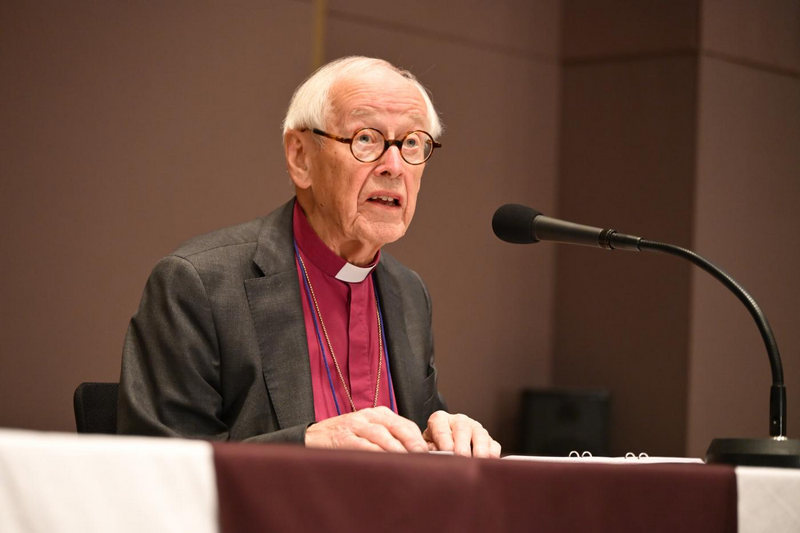
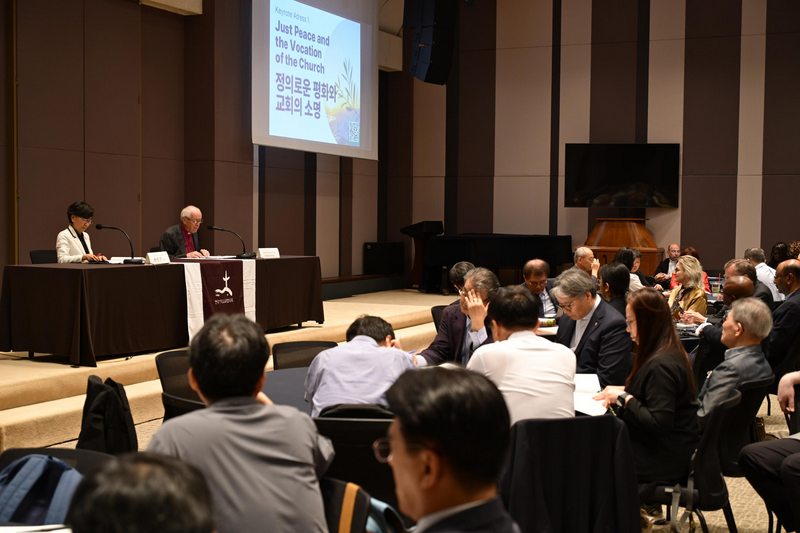

Bishop emeritus Dr Jonas Jonson, during a keynote address at the International Ecumenical Peace Convocation in Seoul, Republic of Korea, spoke on "Just Peace and the Vocation of the Church." He began by positing that, even in apocalyptic times, believers are ceaselessly called to plant in faith what may blossom and bear fruit in an unknown future.
"We convene amid compounding climate change and full-scale wars, fueled by militarization and the rapid proliferation of lethal autonomous weapons," he said. "We witness rising nationalism, democratic backsliding, inter-religious tensions, and mass migration, alongside attacks on underfunded and weakened global institutions."
He spoke on how the church is called to witness to and practice a peace rooted in justice in today's world.
"Regrettably, Christianity – like other world religions – has re-emerged as an active and potent force also serving destructive political interests," said Jonson. "The Russian president has strategically weaponized the Russian Orthodox Church to justify his full-scale war in Ukraine."
Jonson also noted that US president Donald Trump constantly invokes rightwing Christian support. "There is a growing misuse of religious language and theological authority to sanctify armed aggression and war, to dehumanize adversaries, and to encourage religious nationalism and extremism," said Jonson. "A significant resistance to the political misuse of faith is arising from within the churches."
He urged churches to raise their voices to protest against any appropriation and politicization of faith. "An authentic Christian message of peace, loving one's neighbor, caring for creation, and welcoming the stranger today is heard as radically subversive," he said. "That is precisely what makes it so urgently needed in the world."
Jonson reflected that the rules-based world order that originated after World War II is shifting toward a fragmented, multipolar system. "At present, only 26 countries out of 167 are rated as full democracies," he said. "More than half of the world's total population live in authoritarian dictatorships which control media and suppress political opposition."
Idealistic internationalism is overshadowed by self-absorbed nationalism, Jonson noted. "During World War I, churches learned that the world was too strong for a divided church," he said. "Therefore, church leaders decided to do whatever possible to strengthen Christian identity, promote church unity, build alliances, and prepare for worse days to come."
At that time, there were no global ecumenical structures, and few people had any experience of international church cooperation, he added. "Now, the situation is much different," said Jonson. "Christianity, including Roman Catholicism and many charismatic churches, is imbued with ecumenical thinking and well connected."
The enthusiasm of ecumenical pioneers has matured into bold initiatives of practical cooperation, Jonson said. "An ecumenical vision has taken root at the local level. The role of international organizations is to coordinate and communicate."
Followers of Jesus Christ should aim at nothing less than a universal ecological civilization – a world where wounds are healed, and righteousness and just peace prevail. However, experience teaches us the need for eschatological patience, Jonson noted. "The full unity of all creation will not come within history, but only as history reaches its completion in God's embrace," he said. "The vocation of the Church of today and tomorrow is to live the faith as a leaven of hope and as a sacrament for the world."
Originally from the World Council of Churches
CCD reprinted with permission