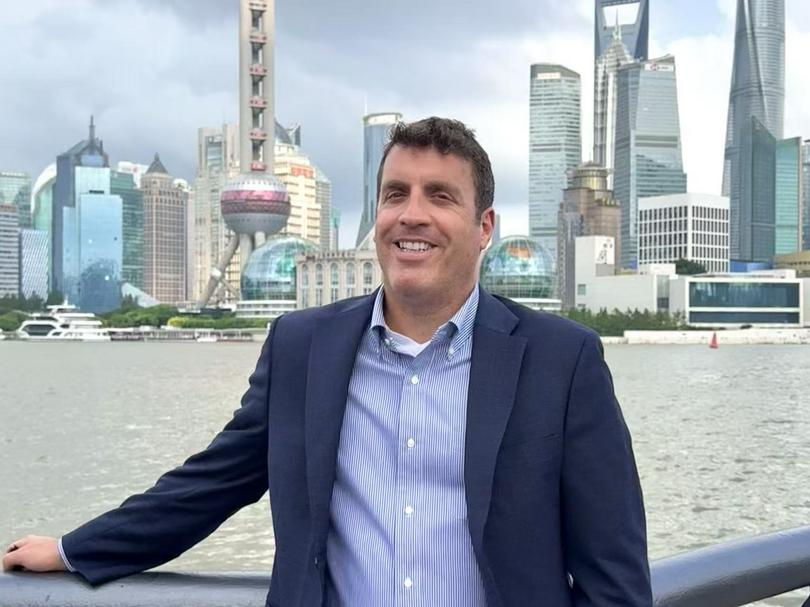
Matan Zamir, Israel's new Consul General in Shanghai, arrived in the city in August for a four-year posting. A ninth-generation resident of Jerusalem, he has spent much of his life and career engaging with people from different religious and cultural backgrounds.
In an exclusive interview with China Christian Daily, Zamir spoke about his first impressions of Shanghai, the city's historical ties to the Jewish community, the similarities he sees between Chinese and Israeli families, and his experiences building relationships with Christian communities around the world.
He also expressed a desire to learn more about Christianity in China during his time in Shanghai and said he hopes to build greater understanding and people-to-people connections between China and Israel.
China Christian Daily: You have just arrived in Shanghai to take up your position as Consul General. What are your first impressions of Shanghai? Is there anything about the city that feels particularly different from your previous diplomatic postings in Mumbai, Boston, and San Francisco?
Matan Zamir: This is my first time in Shanghai, and the first thing that came to my mind is how powerful the city is. I can feel the energy both from the city itself and also from the people I meet in the streets, restaurants, and shops. I've received a very warm welcome.
I know the history and the background of the city. During World War II, about 20,000 Jews came to Shanghai and were able to be saved from Nazi Germany. I know how important Shanghai is to the Jewish community and the State of Israel. I feel grateful to be here.
China Christian Daily: You were born in Jerusalem, and your family has lived there for nine generations. What does Jerusalem mean to you personally? How did the city's religious and historical heritage shape your upbringing?
Matan Zamir: Jerusalem is my home and the city that I love the most. I'm the ninth generation in Jerusalem. My family came from the Jewish Quarter of the Old City in Jerusalem, so Jerusalem means the world to me.
When I went to law school, I was a tour guide in Jerusalem. I used to take groups from Israel and other countries around the city. My first stop was a medium-sized building, and I would ask the group, "What is this building?" Most of the people did not know.
Then I would tell them that this medium-sized building is one of the holiest places for all three monotheistic religions—Christianity, Judaism, and Islam. On the top floor is the room of the Last Supper, and right beneath the room is, according to Jewish belief, the Tomb of King David. According to Islamic tradition, the building is also the last station Prophet Muhammad had before going to the Temple Mount and from there to heaven.
So, one medium-sized building is very holy to all three religions. The reason I used to start my tours there is that it's a good symbol of what Jerusalem is all about: how important the city is to the believers worldwide.
China Christian Daily: China and Israel are both civilizations with long and rich histories. Despite their very different cultural backgrounds, what common values or experiences do you think can help Chinese and Israeli people understand each other better?
Matan Zamir: It may seem like there are not many similarities because China is massive and Israel is rather small, but when we look down into an individual household, you realize how similar we are.
One main example is the significance and the importance that both Chinese people and Israelis place on family values. In Israel, the image and role of parents and the importance of the family unit are very significant. The family is at the heart of every person in Israel, and I think it's the same thing here in China.
Second, both people value knowledge and education. We learn about the world and the things that surround us, from science to innovation and technology, but also learn about our own background and tradition. Why are we Jewish? Why are we Chinese? The same tradition echoes from one generation to another, which is a prominent element in Israeli society. I think this also applies to Chinese society.
China Christian Daily: As a lawyer and former head of democracy education at the Israeli Supreme Court, you have worked at the intersection of law, society, and public education. What have these experiences taught you about how a society can respect differences while maintaining a shared sense of community?
Matan Zamir: In my opinion, diversity is power. A diverse nation is a more powerful nation because you don't have an echo chamber of similar people who are doing the same and thinking the same things. If you bring people from different places, with different backgrounds, religions, and ethnicities, you get different opinions and ideas. This translates into a more interesting culture, a country with more entrepreneurship and innovation. It is better for both business and culture.
It also makes better food! In a country like Israel, when you have tastes from around the world that are diverse, and then you mix them, that creates amazing food. Wherever you go, if you look at a diverse society, you get a more colorful rainbow with more opportunities. That is a strength to a nation or to a society.
But I do want to say that, as somebody who is a lawyer with a law background, at the end of the day, in Israel, everybody's equal in the face of the law. We are diverse, but when it comes to a law-abiding society, we are all equal.
China Christian Daily: You have also worked in public diplomacy and diplomat training. What role do you think education and cultural exchange can play in building understanding between people of different religions, cultures, and nationalities?
Matan Zamir: At university and in my previous position, I was the director of the Political Cadet Training Program at the Israeli Foreign Ministry. I had a very strong responsibility of training the next generation of Israeli diplomats.
When I was their director, I loved training cadets from different backgrounds and different ways of life in Israel because they brought interesting voices and interesting opinions to the training.
When you get to know different people and their backgrounds, it also reduces fear. Often, fear comes simply from not knowing who the person in front of you is. Once you know them better, you can say, "Okay, so they might think a little differently than me, but they're not terrible, and we can have a meal together, or we can sit together, or we can have an exchange of ideas together."
I think this is a key to peace. If you reduce unfamiliarity, you build bridges. At the end of the day, on a personal level, but also on a state level, this is the key to bring peace between people.
China Christian Daily: Judaism and Christianity share deep biblical and historical roots. How do you view the relationship between Jews and Christians today, and what opportunities do you see for greater understanding between the two communities?
Matan Zamir: I'm fortunate to have worked a lot with Christians in my previous positions. When I was in Mumbai, India, on my first diplomatic mission, and later in Boston and San Francisco in the United States, I was fortunate to meet Christians from different denominations.
If I have to narrow it down to the core, it all stems from the Old Testament, which we all believe in, with our perhaps founding father, Abraham. It's a good place where everything started. Over the generations, differences emerged, but I think that if we focus on what unites us, that is a good key to start a dialogue and build a relationship. I had incredible relationships during my time as an Israeli diplomat with different churches around the world. I was always welcomed with an open heart and open hands, and we had fruitful discussions.
Many times, I came as a listener. I listened to beautiful choirs singing, and I paid respect to a faith that's not my own but one that I can very much relate to. Then I conducted conversations with pastors and community members and learned about how we could build these bridges between Jewish and Christian communities.
Many times, it worked very well because there was willingness from both sides to get to know each other. These relationships could quickly turn into mutual events—celebrating Pesach (Passover) and Easter, Christmas and Hanukkah together, and organizing community charity events. The potential for cooperation is huge, and a lot of the time, it worked well.
What unites us is way more powerful and stronger than what divides us, again, because we all stem from the same root. It can also translate to Islam, because, again, it stems from the same place.
A good example is the Abraham Accords, signed six years ago between Israel and some of our neighboring countries, because we realize that we have very similar roots. This is a key to expanding the circle of peace in our region in the Middle East, and hopefully, from the Middle East, this can translate to the rest of the world.
China Christian Daily: Many Chinese Christians are interested in Israel and Jerusalem because of their connection to the Bible. What aspects of contemporary Israel would you especially like them to know more about?
Matan Zamir: I would encourage every viewer to come to Israel. Take two weeks and visit the Holy Land. A visit to Israel can be a once-in-a-lifetime experience! I would advise people to come for not less than two weeks because there's so much to see.
On one hand, you are walking the footsteps of history, from Jerusalem to Nazareth to the Sea of Galilee. You are seeing the places that you have been learning about, and reading about, and praying about.
China Christian Daily: What would you like to learn more about Chinese Christians and Christianity in China during your time in Shanghai?
Matan Zamir: I have to admit that I don't know much, but I'm here for four years, and I'm here to learn. I want to learn everything.
I want to meet the community and know the way you worship and pray. Every time you want to invite me to learn more about the community, I'm open to coming and seeing the meaningful work that you do.
China Christian Daily: Looking ahead, what opportunities do you see for greater cultural and religious exchange between China and Israel?
Matan Zamir: There's been an incredible partnership over the last 35 years. We are now celebrating 35 years of bilateral relationships between China and Israel in many fields, including innovation and technology, culture, and tourism, and we have goals to improve them.
We can have more business cooperation, cultural people-to-people interaction, and mutual visits.
As I said before, people can walk in the footsteps of history, but they can also see a vibrant Israel that has more to offer than only archaeological and historical sites. There is a lot of tasty food and many places to visit. For example, the Dead Sea is a good spa destination. My main goal here is to increase tourism and build more bridges between China and Israel.