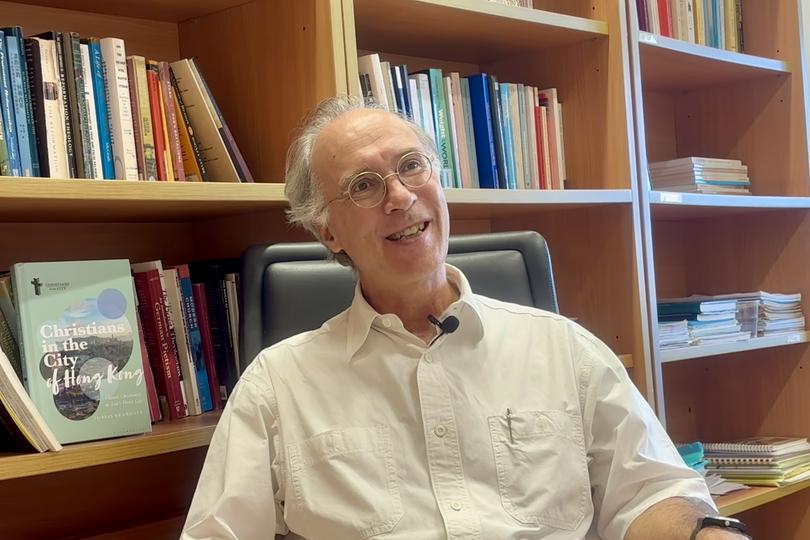
Originally from Switzerland, Tobias Brander came to Hong Kong with the Basel Mission in 1996. Having lived in Hong Kong for 29 years, he worked first as a prison chaplain and now teaches at the Divinity School of Chung Chi College, Chinese University of Hong Kong as an academic professor. Also a church worker, Brander has been involved with many different groups of people, ranging from the homeless, people in substandard housing, drug traffickers, to rich people, people who work in high finance, and in property. With the engagement of widely different people in Hong Kong, he wrote the book Christians in the City of Hong Kong in 2023, as a portrait of Christians in the city. In an exclusive interview with China Christian Daily, Brander talks about the book and the diversity of Christianity in Hong Kong.
China Christian Daily: Could you please introduce the book?
Tobias Brander: It is a portrait of Christians in Hong Kong, describing its diversity, different denominations, how Christians are involved in society, mainly through education and social work, how they are involved in cultural life, how they serve the community, and how they have been involved in political change. Ultimately, it asks, "Is there something like theology in Hong Kong?" We understand that all theology is local theology, which is an expression of our faith shaped by our context.
China Christian Daily: Why did you write this book?
Tobias Brandner: I wrote it because this is part of a series of books on Christianity in the "Global City," with cities chosen from each continent. I learned about this project and felt strongly that Hong Kong, a great and special city close to my heart, had to be included. After encouraging others to submit a proposal without success, I had a moment of inspiration during a COVID quarantine at 2 a.m. and decided to write it myself. As a non-Chinese person who has lived here for nearly 30 years, I am in a unique position—not fully local, but not fully a foreigner. This allowed me to connect my many personal encounters and my love for the city and its people with the academic reflection I am trained for. The book is a bit like a testimony of my life in Hong Kong.
China Christian Daily: What is the local theology in Hong Kong?
Tobias Brandner: There are two kinds of theology: implicit (or I call "lived") theology and explicit theology. Implicit theology is expressed in how the church is managed and structured. For example, an important image is "the church as a family." Shaped by the Confucian understanding of the family, the church in Hong Kong is often patriarchal and relatively hierarchical, where obedience is important. Another example is that people in Hong Kong are business-minded, and they carry this into the Christian context. Local Christians often live their faith with a business-minded attitude, wanting to grow, become bigger, and be more successful.
Explicit theology in Hong Kong can include post-colonial theology and Sino-Christian theology. Post-colonial theology is aware of how much theology has been shaped by colonial structures. Hong Kong has a unique structure of governance and a legal system influenced by the colonial power of the United Kingdom, such as freedom of expression and civil rights. Hong Kong Christians are somewhat "hybrid": they are Chinese, yet in many ways Western, and can be a bridge between the East and the West.
The other is Sino-Christian theology. The Tao Fong Shan Christian Centre, which houses the Institute of Sino-Christian Studies, promotes Western theology in the Chinese context and Chinese theology in the Western context, building on this exchange. Here again, Hong Kong has this bridging function.
China Christian Daily: Who are the readers of this book, and is there any feedback from this book?
Tobias Brandner: The reader I had in mind was the average person, not an academic, although it is an academic book published by Bloomsbury Academic. I wanted to write in a way that is attractive to ordinary people, both Christians and non-Christians. I've received positive feedback from many people, even those who are theologically very different from me. I myself am a very ecumenically-minded Christian, or what I would call "spiritually progressive." I understand there is a diversity of legitimate forms of Christian faith expressions; there is not one right way. I have learned to appreciate different traditions, for instance, while I am not a Pentecostal myself, I have learned to appreciate Pentecostal and Charismatic Christianity and see their bright contribution to the whole Christian movement.
China Christian Daily: Suppose you were to introduce Christianity in Hong Kong to foreign people, how would you describe it?
Tobias Brandner: I would first say that Hong Kong is one of the greatest cities in the world. The people are passionate and hard-working, but also have a great sense of enjoying life. The city is beautiful and unique; you have the dense, vibrant city life, but also the wilderness of nature, mountains, and the sea. It's extremely convenient and well-organized.
As a Christian, what I like here is that many Christians take their faith very seriously. They live their faith with passion. They contribute and share, also financially, supporting fellow Christians, mission outreach, and the social ministry of churches. It's a pleasure to work together with these people and to be part of this community, which is very supportive of many initiatives that contribute to society.
China Christian Daily: Could you please give a picture of Christianity in Hong Kong?
Tobias Brandner: Christianity in Hong Kong is a "cognitive minority," maybe 15% to 20% of the population. Christians are found in all parts of society, but are very much present among the well-educated. A key feature is their strong involvement in education and social services. Nearly 50% of all schools in Hong Kong are managed by Christian churches. These schools teach academic subjects but also communicate spiritual values like respect, love, and honesty, and they build a link to Christian churches.
They are also very involved in social work, from drug treatment and helping street sleepers to advocacy. One important historical group is the Christian Industrial Committee (CIC), which was very active in the 1970s, promoting better conditions for workers. They saw societal change as part of God's mission for justice. This Christian NGO contributed tremendously to social improvement through its advocacy work.
China Christian Daily: Let's dive more deeply into the book. The first chapter is about space. Why did you start with space?
Tobias Brandner: I believe that the material presence of Christianity tells a story. In a dense city like Hong Kong, there is not enough space for every church to have its own building. So, many churches are located somewhere between the second and seventh floors of a residential or business building, or even on the 20th floor. This tells something about the uniqueness of Christianity here. The chapter also looks at free-standing churches, some designed in a very Chinese, contextual way.
Furthermore, the chapter is about the role of money. The practice of giving is very important and makes the churches here quite robust. This is because they understand their congregation as a family. In a family, you share and support each other. So Christians extend this solidarity to their brothers and sisters in the congregation, which is why tithing and giving are so strong.
China Christian Daily: The second chapter is about the churches. You claim that most of them are evangelical, while some may be Pentecostal, which is different from churches in Seoul or Singapore. Could you give a general picture of the churches there?
Tobias Brandner: I distinguish [churches in Hong Kong] between three groups: ecumenical churches (often historical ones), evangelical churches, and Pentecostal-charismatic churches. Numerically, the largest churches are evangelical, including the Baptist Church, the Christian and Missionary Alliance, and the Evangelical Free Church. What is interesting is that Hong Kong has fewer mega-churches compared to Singapore or Seoul. This probably has to do with the "church as a family" model; people prefer smaller groups where they can know and care for each other.
The other important finding is that while Pentecostalism is growing worldwide, the biggest churches in Hong Kong are Evangelical. My explanation is the strong Confucian background in the Chinese context. We can see Evangelicals as a kind of "Christianized form of Confucianism"—more orderly, emphasizing teaching, learning, and authority. In contrast, some say Pentecostalism is the "Christianized form of shamanism or Daoism," which is less orderly but emphasizes supernatural events.
China Christian Daily: In the book, you also talk about the influence of Confucianism and Daoism on Christianity in Hong Kong. Do you think the churches in Hong Kong need any adjustment, or is this just contextualization?
Tobias Brandner: I wouldn't want to be judgmental; I observe strengths and weaknesses in all forms. But I would say this strong influence of Confucianism surely has its problematic side. For instance, many young people have been turning away from Christianity because they find its present form too focused on teaching and submission to the authority of the senior pastor. A colleague found a trend of young people moving from local Chinese-speaking churches to international churches, not for the English, but for the different atmosphere. The pastor there is more approachable, like "Bill" or "John," not always addressed by a formal title like "mùshī" (pastor), which creates distance. So there is a certain formalism in Confucian-based, evangelical churches—particularly the more conservative evangelical churches—and this authority structure of the senior pastor is something that some young people nowadays question. That's maybe one point of criticism, but first of all, it's an observation of something that is happening.
China Christian Daily: In your lecture in January 2025, you noted that there are over 150 international churches in Hong Kong. Can you give a general picture of them?
Tobias Brandner: I did find that there are probably around 150 non-Chinese-speaking churches. These may be Korean churches, Filipino churches (mainly with migrant workers from the Philippines), Indonesian-speaking churches, German-speaking churches, or Japanese-speaking churches—all possible kinds of churches. And of course, many English-speaking international churches.
There are also a significant number of Nepali churches, and about 15 churches set up by pastors from Africa. Important ones, like The Vine or Island Evangelical Community Church (ECC), are professional with great preachers. We see many local young people going to these churches, perhaps out of frustration with the formalism of local churches. This situation reflects the "hybridity" of local people, standing between the East and the West.
China Christian Daily: In your later chapters, you talk about social engagement. How exactly do they get involved?
Tobias Brandner: Christians in Hong Kong are strongly involved in all parts of society and in all different methodological forms. This includes charitable work, individual casework and counseling, and advocacy for social and policy change. Christians have been involved at all levels. Christian groups managed about 50% of schools, which had a profound impact by making Christianity a familiar presence for many in Hong Kong, even if they didn't convert.
What I find particularly important with the social engagement is that Hong Kong Christians were successful in negotiating with the government, in navigating a middle road. Traditionally, some of these social ministries have been very much supported; they received funding from the government because they did the necessary social work that the government was grateful someone was doing. For instance, treatment for drug addicts. This is obviously a social need. Many Christian NGOs have taken this up, and they do it probably better than any non-faith-based organization. Faith plays an important role in drug treatment. The same could be said in many other areas. But at the same time, this form of cooperation has not kept Christians from also critically intervening and calling for structural change in policies for the poor.
This dual strategy was highly successful in the past. In response to Hong Kong's recent political and structural changes, Christian organizations are now readjusting, a process I believe they are managing quite successfully.
China Christian Daily: What about Hong Kong churches' contribution to global missions?
Tobias Brandner: Hong Kong people have been very generous, and churches have supported about 700 missionaries to go all over the world. Traditionally, the mission field was foremost China, though this was in a legal gray area. In the past years, Christian missions have diversified. Nowadays, the most important destinations for missionaries are Thailand, Cambodia, and Japan. But there are also missionaries in the Middle East, in Africa, and elsewhere.
China Christian Daily: What do you think are the challenges and opportunities for churches in Hong Kong?
Tobias Brandner: The first challenge is surely the changing political context since 2020. Christian activists have to find different ways of adjusting. The central government is taking a more proactive and visible role. Another challenge is the wave of migration, as many active church members have moved away from Hong Kong. So, a future opportunity and challenge will be to reach out to the new people who come in from mainland China. To reach out to these new residents and rejuvenate our Christian community will be a major challenge.
China Christian Daily: What about the interaction with the Chinese mainland?
Tobias Brandner: This has been ongoing. Hong Kong churches have played a major role in supporting Christians in the Chinese mainland: building churches, providing theological education, and grassroots training. I know so many pastors who used to regularly go to China for a week, two weeks, or even just two days, and they would teach in a classroom at a low-level training center where grassroots church workers were educated. They tried to teach them about the Bible, church management, and how to build a good, well-working, vibrant church. I think this will go on, but nowadays, with stricter supervision, it will need to be a more low-key, discreet form of contact. Of course, there are also the more official contacts, with church leaders from Hong Kong visiting leadership in Shanghai or Nanjing, or elsewhere—the top leadership—and maybe also visiting the political authorities in China.
China Christian Daily: Do you have any lessons or words for Christians in the Chinese mainland?
Tobias Brandner: I feel equally moved by and grateful for Christians in the Chinese mainland, whether they are in official Three-Self churches or in house churches. I believe we are all brothers and sisters in Christ. We can show resiliency in times of adversity and keep strong in our faith. What is special about our Christian faith is that we connect on a deeper level—beyond national identity, ethnicity, or political orientation. There is so much conflict in this world growing out of nationalism. I believe that as Christians, we should be peacemakers beyond national interests, remembering that fundamentally, we are first and foremost brothers and sisters in Jesus Christ.
China Christian Daily: The last question is about your prison ministry. It seems very special.
Tobias Brandner: The prison ministry is a part of the British heritage, where a prison chaplain is common. As a chaplain, I have a special permit to be present in the prison. I reach out to all people in prison, independent of whether they believe in Jesus Christ or Buddha or whatever. I try to show them the power of forgiveness that Christ taught us, telling people that all of us are sinners in need of forgiveness. I try to tell them, "Look, no matter what your background is, you are still a loved child of God. God cares for you, and God does not give up on you." I try to communicate this message of love in the prison context. I do believe it is a very special ministry, and I am very passionate about this ministry.