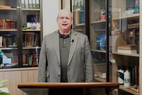
Rev. Fr. Dr Lawrence Iwuamadi is the academic dean of the Ecumenical Institute at Bossey and also a Roman Catholic priest of the Archdiocese of Owerri, Nigeria. Commissioned by the Vatican for promoting Christian unity to the World Council of Churches (WCC) and ecumenical education since 2012, he has taught ecumenical and biblical hermeneutics and led workshops on intercultural biblical studies in Bossey, Geneva.
The Global Ecumenical Theological Institute (GETI) 2025, themed "Where Now for Visible Unity?" and held alongside the Sixth World Conference on Faith and Order, gathered 80 young people on October 12–29 at Saint Bishoy Monastery in Wadi El Natrun, Egypt. Lawrence Iwuamadi served as the teacher at GETI 2025 and was also a participant of the conference.
China Christian Daily: What are your takeaways from this conference?
Rev. Fr. Dr Lawrence Iwuamadi: The first takeaway is hope. As Christian unity is a gift of God, the commitments or recommitments I saw in this gathering are a sign of hope, not just for churches working toward Christian unity, but also a hope for a world that is experiencing changes. This is a time that our world needs hope more than ever.
For me, who teaches ecumenical formation, it's a huge hope to see the number of young people represented in this conference, who were keen to learn about ecumenism and Christian unity. It's a hope for the future.
China Christian Daily: Share with us those young people in the GETI 2025 program.
Rev. Fr. Dr Lawrence Iwuamadi: WCC has two major education programs: the Ecumenical Institute at Bossey, affiliated with the University of Geneva, and the Global Ecumenical Theological Institute (GETI). GETI follows all the big gatherings of WCC, and the next gathering will be about mission. The place has not been decided, but I think it may be in Asia, the Pacific, or the Middle East.
At the GETI program, students from all over the world learn about the history of the ecumenical movement, Christian unity, different churches, and also how to integrate discussions about the church into contemporary society. As the world is facing all sorts of crises—migration, hunger, war, economic instability, and the rise of political nationalism—how can the church and young people contribute to a society that is good for all through their learning of the past?
China Christian Daily: How can people apply for the Ecumenical Institute at Bossey?
Rev. Fr. Dr Lawrence Iwuamadi: Go to the website. There are three programs: the Master of Advanced Studies in Ecumenical Studies, which starts in September and ends in June, and two certificate programs, which last from September to the end of January, where the majority of students enroll. For those whose university certificates are recognized by the University of Geneva, go to Complementary Certificate (CC) in Ecumenical Studies, and for those not, go to Certificate of Advanced Studies (CAS) in Ecumenical Studies.
There are two Chinese students at the Ecumenical Institute at Bossey for the certificate program to study ecumenism in Switzerland till the end of January. Chinese students normally come through the China Christian Council and return to China after the study.
China Christian Daily: Have you observed any new trends or questions among your students about unity or mission?
Rev. Fr. Dr Lawrence Iwuamadi: This year, we have 31 students from 23 countries from around 22 or 23 churches. Although each context influences their curiosities and needs, they think of the church not just as a church that proclaims the good news, but as the church that can help today's society through the changing times and realities. The questions can be about human sexuality, politics, wars, and social situations, but there are core theological interests: Why can't we share the communion? Why do the churches not recognize the ministries or the nations of others? There has been a consistent desire to know the other: only when you come close to a person are prejudices and biases erased.
China Christian Daily: As someone deeply involved in theological education and ecumenical dialogue, what do you see as the most pressing issues the global church must face to move toward visible unity today?
Rev. Fr. Dr Lawrence Iwuamadi: Churches have different understandings, for instance, of what a church is. There is no common definition of "the church," regardless of being an Orthodox, a Protestant, or a Roman Catholic. This also applies to unity: Is it a unity visible in a certain sense?
The conference raised the question of "Where are we with Christian unity?" Everybody agrees that we need unity, but the understanding of what unity we are seeking is still problematic until we come to an agreement.
The other thing is that some churches are more inclined towards social justice, while others are towards the core theological questions that have been historically divided. There must be Christ in the question, and we have to ask, is this Christ truly human and truly divine?
China Christian Daily: Share with us about the situation in Nigeria.
Rev. Fr. Dr Lawrence Iwuamadi: Nigeria is a big country with a population of about 230 million. It is said that every fifth African is a Nigerian.
In terms of religion, half are Muslims and the other half are Christians. This 50:50 proportion plays out in the current religious tensions because either side wants to ensure its presence. In the northern part, where there are cattle areas, Christians are the farmers. Some people would say that because of climate change, there are no more grasses, so Muslims take their cattle into the farmlands and destroy the agricultural products, which belong to the Christians. This has been an economic issue that ends up being religious in the long run.
Another challenge is insurgent groups or terrorist groups called Boko Haram, so Christians in the north are constantly under persecution. They live out their faith in fear but remain strong, committed, and resilient. There is ecumenical collaboration among Christians in the north because they have common challenges.
Christians in the South don't face persecution and are free to exercise their faith. Many Christians are committed, and it will be one of the strongest areas for the growth of Christianity at its peak. However, sometimes, people take their faith for granted and live in a situation of relaxation.
Nigeria is so big that it depends on where you are. The west and the east are different. There is a good collaboration between the Protestants and the Catholics and some challenges with the Pentecostals. Ecumenism is at work.
China Christian Daily: Africa was colonized by the Europeans, so is there any indigenization movement of Christianity?
Rev. Fr. Dr Lawrence Iwuamadi: African independent churches emerged because the Anglican church did not allow them to use drums and the local languages in church worship. They are traditional Protestants.
In the Catholic Church, especially after the Second Vatican Council, the inculturation move enables congregations to use local drums, songs, decorations, and fabric vestments. As long as it is not contrary to core teachings or indicates syncretism, which mixes traditional religion with the traditional church, the Catholic Church doesn't have any problems with this.
China Christian Daily: What are the contributions of the local church to society?
Rev. Fr. Dr Lawrence Iwuamadi: Africans are basically religious people, so in a Christianity-dominated society, Christian ethics and values play an important role. If there is an election, Christians vote in accordance with Christian ethics. In that sense, Christians can make an impact.
China Christian Daily: What help does Nigeria need?
Rev. Fr. Dr Lawrence Iwuamadi: As a Christian, prayer is the main thing. Second, regarding persecution, put it out in the news and let the world know. The mainstream media in Europe don't cover the real situation in Nigeria or in Cameroon. Look at South Sudan and Congo, DRC. We don't produce arms in Africa, so where are the arms coming from? Where did the rebels and terrorists get the money? In some African countries, they are better armed than the government, so who is funding them?
China Christian Daily: Do you have any words for China?
Rev. Fr. Dr Lawrence Iwuamadi: I love China. China is a great country, basically from my interaction with students and friends. So I wish you well.