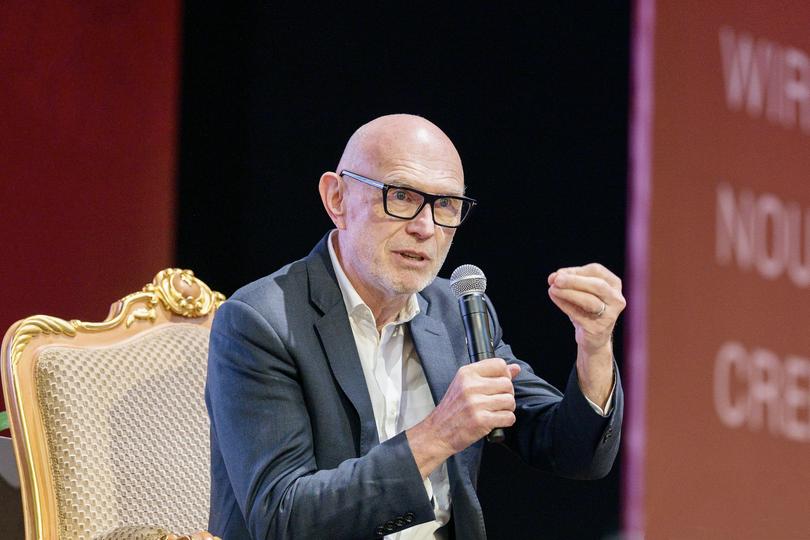
Born in Croatia and mentored by the late German theologian Jürgen Moltmann, Dr Miroslav Volf, the Henry B. Wright Professor of Systematic Theology and the Founding Director of the Yale Center for Faith & Culture at Yale University, is widely recognized as one of the most influential Christian theologians engaging the relationship between faith and contemporary life.
He is the author of Exclusion and Embrace: A Theological Exploration of Identity, Otherness, and Reconciliation, a landmark work shaped by his experience of ethnic conflict in the former Yugoslavia. The book was named one of Christianity Today's "Century of Books" and received the 2002 Grawemeyer Award in Religion. Volf's writings consistently explore how Christian faith speaks to everyday life and the common good. His other major works include Free of Charge: Giving and Forgiving in a Culture Stripped of Grace, The End of Memory, and A Public Faith: How Followers of Christ Should Serve the Common Good. These books, all available in Chinese translation, have resonated with believers seeking to live out their faith faithfully in complex social realities.
Beyond academia, Volf has been featured in major U.S. media outlets such as The Washington Post and Christianity Today, and he has taught widely in universities and seminaries across Central and Eastern Europe, Asia, and North America. He also co-led the Faith and Globalization lectures with former U.K. Prime Minister Tony Blair, a three-year initiative examining how faith can be lived responsibly in a globalized world and how it might contribute to the humanization of global processes.
In this exclusive interview with China Christian Daily, Volf reflects on how faith connects with lived experience, drawing on his work on reconciliation, forgiveness, community, human flourishing, and the question of what makes a life truly worth living.
China Christian Daily: You are often described as a "theological bridge builder," who connects Christian theology with various realms of public life. How do you understand this role, and how does such bridge-building work in practice?
Miroslav Volf: My main theological interest is to explore how faith connects with lived lives, and not just in public but in private as well. We often live in estrangement and even enmity with one another. The task, then, is to look for ways to reconcile, without overburdening the idea of reconciliation with the expectation of perfection, of the absence of tension. In this—in my work as a theologian of the bridge—I am guided by two convictions, one that is explicitly stated in the Gospels and one that we can infer from Christian anthropology. Though these convictions are rooted in the Christian faith, they find resonances, to a degree, in many traditions.
The first conviction is that we should love all people, not just those who like us and are like us, but those who are different, strangers, even enemies. God, Jesus said, "makes his sun to rise on the evil and on the good, and sends rain on the righteous and unrighteous." As God does, so should those who believe in this God.
The second conviction is that we all have complex, dynamic, and partly overlapping identities—with partly porous boundaries (a point I made in my book Exclusion and Embrace). I am always what I am because I am in relation to others; my identity is never "pure." To live in peace, we need to embrace these two convictions and apply them to our relations between individuals and between groups. For me, this is for me the main work of bridge building.
I am also interested in the role Christian faith plays in various domains of life— economics and politics, above all, even when that role turns out to be a negative one.
China Christian Daily: In Exclusion and Embrace, you explore how Christian theology can offer a constructive response to deep social and ethnic conflicts. How do you see your theology of "embrace" being applied in today's polarized societies?
Miroslav Volf: It is, of course, impossible to give a full answer here—and in each setting the answer will have to be slightly different. But for each one of us, it means resisting being sucked into the reigning social polarities. It means resisting dehumanizing others and instead honoring them in their humanity. Even when they treat us as enemies, we should shine on them with love as the sun shines on the righteous and the unrighteous. I call this a radical "will to embrace." It involves refusing to zero in only on what separates us and on what we find wrong about others and, instead, recognizing the good that is in them, in their motivation, and in their aspirations. Put differently, we build a bridge on which we can encounter others and work toward reconciliation.
China Christian Daily: You write about the challenge of reconciling when neither side is purely victim nor purely perpetrator. What are the first steps toward a genuine embrace in such contexts?
Miroslav Volf: In most cases with some history, cases that are not simply a burst of violence out of the blue (say, a robbery), neither side is purely a victim or purely a perpetrator; both are both, even if often in a different measure. The difficulty is that both parties tend to see themselves as only victims—or as those who struggle to redress having been wronged—and to see the other only as a perpetrator, as the wrongdoer. Opening the eyes of victims to see that they, too, are perpetrators (even if not as egregious perpetrators as those who violated them) is often a necessary preliminary shift in perspective that opens the possibility of making the first step toward reconciliation, to bring into being "the will to embrace" the other. This is the most difficult step. In the Christian faith, it is motivated by one of the central commands: to love the enemy, the wrongdoer. But even when this first step has been made, reconciliation is not guaranteed. The other party must desire the embrace as well and, when it wills embrace, not place impossible conditions on it.
China Christian Daily: In Free of Charge, you describe forgiveness and generosity as gifts of grace rather than moral achievements. How can churches cultivate this spirit in cultures shaped by competition and performance?
Miroslav Volf: I do think of generosity—whether in the activity of forgiving or of giving—as itself a gift of grace. In fact, I believe that our entire lives are gifts: our existence, our capacities, our motivations, our ability to work hard, even the social environment in which we are raised. We are agents, of course, but our agency is also conditioned in various ways, made possible by others. So I don't know where, in my agency, what I receive ends and what I contribute begins. All this means that I cannot legitimately ascribe to myself any superiority I may have over others. Leaning on Søren Kierkegaard and John Milton, I have argued in my recent book The Cost of Ambition: How Striving to Be Better than Others Makes Us Worse that we should strive for excellence, not for superiority, and that superiority is an empty value, false and detrimental for each individual, as well as for society and the environment. Thinking of myself as superior to someone is to lie to myself and to use that lie to put the other down. The idea that all that I am and am able to accomplish is grace helps me in the struggle against the vice of striving for superiority.
China Christian Daily: Your upbringing in Croatia during turbulent historical times has informed much of your work. How has your personal story shaped your theology of reconciliation and forgiveness?
Miroslav Volf: I was actually raised in the former Yugoslavia. It was a socialist country when I was growing up, under the leadership of the communist party. The Christian faith was mostly tolerated, but within certain bounds, and Christians were sometimes mistreated by overzealous members of the party. A silly example: In the civil engineering high school that I was attending, one teacher decided that because I was a Christian, I could not get the best grade in the subject "Concrete," even though I was the best student. It did not matter that concrete is concrete, whether you are a Christian or a communist. My parents taught me not to be bitter or vengeful when mistreated, but to be fair, honor everyone, and appreciate what is good. During the war after the breakup of Yugoslavia, I applied that same principle to the relationship between people who belong to warring ethnic groups. I have applied this lesson in my scholarly work as well. I have benefited much, for instance, from some atheist thinkers, like Karl Marx (on whose concept of work I wrote my doctoral dissertation) and Friedrich Nietzsche (who is one of my favorite thinkers and whom I have read repeatedly over the past 40 years), and I now co-teach a course at Yale on both of them.
China Christian Daily: Across your many books, love, forgiveness, and community recur as central theological themes. What gives you hope for the future of the church and the world?
Miroslav Volf: The way we generally think of hope is to look for reasons for hope in the current state of affairs. We seek to understand the current situation in the church and the world, extrapolate from that situation into the foreseeable future, and then we either hope or despair, or perhaps are uncertain. When we base our hopes on extrapolation, our hopes are limited to the possibilities given in the present. The future is only an extension of the past. But there is another kind of hope, one that counts on something new happening in history, as my teacher, Jürgen Moltmann, who is well known in China, has argued in his Theology of Hope. This is hope based on God's promise. God comes to Abraham and tells him that he and his aged wife and he will have a son—and Isaac is born. Or God comes to Moses and tells him that, all the might of Pharaoh notwithstanding, the slavery of the children of Israel will end. It is that kind of hope that I have for the church and the world. It is based on God's promises.
China Christian Daily: What is a life worth living according to your book Life Worth Living: A Guide to What Matters Most?
Miroslav Volf: The book is based on the course that, together with a brilliant student, I started teaching at Yale Divinity School around 12 years ago. Today, it is the most popular humanities course at Yale and, due to the work of my colleague Matthew Croasmun, versions of it are being taught at around 70 institutions worldwide. We have a global group of teachers who meet regularly to discuss and refine the novel pedagogy we have developed to teach the course. Like that course itself, the book, which is based on it, does not advocate for any particular account of a life that is worth living. Instead, it seeks to do two things. One is to elevate the importance of the question that has largely disappeared from our educational and cultural institutions today. I believe that "What kind of life is worthy of our humanity?" is the most important question of our lives, and yet we rarely think rigorously about it. We have to answer that question before we can responsibly tackle any of the great problems that loom large on humanity's horizon.
The other goal of the course and the book is to familiarize people with the answers that the great philosophical and religious traditions have given to that question—whether those are ancient traditions (like Confucianism, Judaism, and Christianity) or modern philosophical traditions (like Utilitarianism, Marxism, or even Nietzsche's philosophy). Each of these traditions makes a claim to be true—and that means that each recommends itself as a way of living a meaningful life, a life that has weight, to every human being. In addition to elevating that all-important but forgotten question, the purpose of both is to teach the student or the reader how to discern responsibly for themselves what kind of life is worth living. You can get a sense of the project on our website.
China Christian Daily: You mentioned that the book will be translated into Chinese. What message would you especially like to share with Chinese readers?
Miroslav Volf: Chinese rights have been bought for Life Worth Living: A Guide to What Matters Most, though, to my knowledge, the book has not yet been published. My hope for that book in Chinese translation is the same as for the English original and for the eleven translations that have already been published. I hope that it will alert people to the singular importance of the question, "What kind of life and what kind of a world is worthy of our shared humanity?" and offer them some tools to answer that question for themselves.
China Christian Daily: You argue that faith remains essential to human flourishing. What resources does Christianity offer that modern societies often overlook?
Miroslav Volf: We live in performance or achievement societies in which success and superiority over others are paramount. As a consequence, modern societies systematically undermine ultimate trust and make us set rather arbitrarily the targets for the arrows of our longing. Take success, for example, which is one of our most prevalent aspirations. What is success? Success is what counts as success, nothing more than what people generally think is success. I find such mindlessness, such shallowness, about what we invest our best years and energies in very sad. At the beginning of his extraordinary book Confessions, Augustine writes famously that we humans are restless until we find rest in the God of Love. God is the One whom we can ultimately trust, in life and in the hour of our death. That same God is the One whose very being presents us—creatures made in God's image—with the shape of a life that is truly worth living. In the story of Jesus Christ, we find that kind of life sketched out.
China Christian Daily: You claim in After Our Likeness that the church's communal life should reflect the Trinitarian God. What are the biggest obstacles for the church today to live out that theological vision?
Miroslav Volf: The church is not a cultural, political, or economic interest group, although it is true that some churches function in these ways. Genuine church is God's church and therefore always a universal church: it is there for each individual, for each community, and, equally importantly, for the whole of humanity and for the whole planet. The one God is the God of each and the God of the whole. One of the key ideas that the notion of "Trinity" seeks to express is that God is love; in God's own being are three "persons" in eternal loving communion. To say that "God is love," isn't simply to say that God loves. If God is love, then God cannot but love; in everything God does, God loves. For the church to live out its own identity as the image of the triune God is for the church to love unconditionally—each individual and the whole world.
China Christian Daily: You write about remembering rightly rather than merely remembering in The End of Memory. In a global moment of "memory wars" over history and identity, what does "remembering rightly" practically look like?
Miroslav Volf: Memory wars are wars—they are not physical wars, but they often turn into prolonged and destructive wars. That's why remembering rightly is socially important. Remembering rightly has a number of elements. The most important one is the commitment to remember truthfully. Truth is one of the first casualties of war. As soon as we make a commitment to truthfulness, we have made a step away from the zone of war toward the zone of reconciliation and peace. We remember rightly when we seek to remember truthfully—even when truth is against us. Another element of right remembering concerns the effect of past traumas on our present behavior. In the Hebrew Bible, there is a repeated call to "remember that you were slaves in Egypt." Mostly, it serves to remind the Israelites not to mistreat the foreigners in their midst, the way they were mistreated when they were aliens in Egypt.
China Christian Daily: At the plenary session of "Unpacking Apostolic Faith—Living the Nicene Creed in Context" during the World Council of Churches' Sixth Conference on Faith and Order in Egypt on October 25, 2024, you said that we should ask the question: "Who is Jesus Christ for us today?" What do you mean by saying that he is a moral stranger in today's world?
Miroslav Volf: Here is what I wrote about this question in my new book with Christian Wiman, Glimmerings: Letters on Faith between a Poet and a Theologian (HarperOne): "Most of what is important to us—looks, money, sex, social esteem, success—does not seem to have been important to him. We have no idea how he looked; he had no possessions of his own; he never had intercourse; when word of him spread in a region, he would withdraw into solitude or go elsewhere; in obedience to God, he seems to have intentionally headed straight into what all those around him thought was a colossal failure. Most of what was important to him—purity of desire, going a second mile, forgiving innumerable times, serving the lowly, for instance—is odious to us. It's not that there isn't any overlap between our values and his—the sick ought to be healed, the hungry fed, the sorrowing comforted—but we mostly want to get paid in some form for such activities rather than doing them freely." Jesus seems an irrelevant moral stranger. And yet, just as such, he is more relevant—even indispensable—to us today than he ever was. I am about to start teaching a course on Jesus at Yale, and I am re-reading slowly and carefully the Gospel of Luke in Greek. The figure that emerges is extraordinary, severe in its beauty, and exposing the shallowness of many of our most ardent aspirations.
China Christian Daily: Have you ever taught or supervised any Chinese students? From your perspective, what theological insights might be especially meaningful for the church in China today?
Miroslav Volf: I don't know enough about the church in China to offer any advice. It would be presumptuous of me to try. I have not supervised any Chinese students, but I have taught many. I generally find them to be excellent students, well prepared for their studies and diligent in discharging their duties. I very much enjoy teaching them—and admire the wealth of a millennia-long culture that they often bring with them, and that becomes manifest in our interactions.