
For the Christian community in China, the year 2025 saw a diverse array of new church dedications. These projects, ranging from rural sanctuaries to urban landmarks, reflect a changing landscape where the church is increasingly adapting to local culture, urban planning requirements, and the need for standardized venues.
While an exhaustive list is impossible given the scale of the country, a review of key dedications reveals distinct trends in how churches are being built—and rebuilt—across China.
Architectural Indigenization
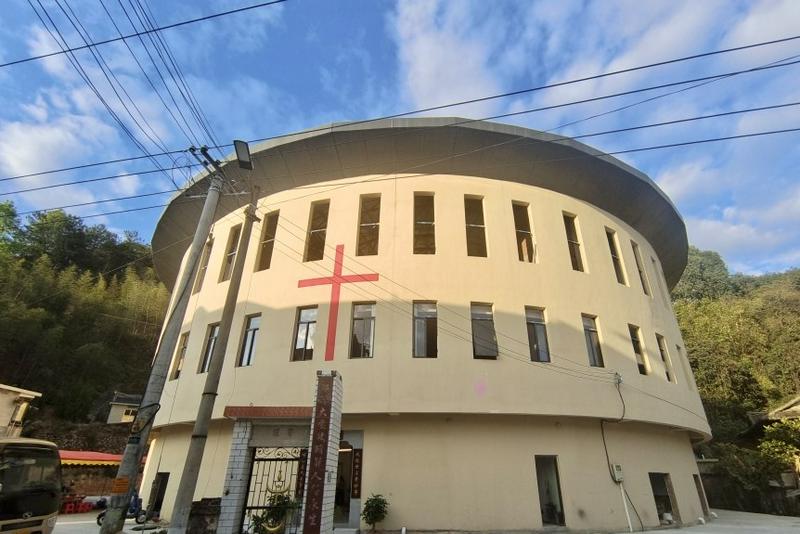
One of the most distinct projects of the year appeared in Fujian Province. On March 14, the Hukeng Tulou Church, also known as "Chengfu Lou," held its dedication service in the Yongding District of Longyan, a region famous for its UNESCO World Heritage tulou (earthen buildings in an enclosed rectangular or circular configuration).
Breaking away from the stereotypical Gothic spires often associated with Western Christianity, this church is the first of its kind to adopt the traditional Hakka tulou architectural style. Built to replace a structure declared unsafe in 2020, the 2,651-square-meter facility serves a dual purpose: a place for worship and a community space with public reading areas. The design represents a tangible approach to the sinicization of Christianity, blending religious function with local architectural heritage.
Urban Landmarks and Design
In major cities, new church buildings are increasingly defined by modern aesthetics and integration into new development zones.
In Zhoushan, Zhejiang Province, the Dinghai True God Church was dedicated on October 25. Reflecting the city's island heritage, the church was designed to resemble a sailing ship. Its façade features a glass curtain wall with 24 gradient shades of blue, simulating the changing light of the ocean from dawn to noon. The sanctuary is crowned with a dome shaped like "praying hands," allowing light to cascade into the hall to create a solemn interplay of light and shadow.
Similarly, in central China, Changsha's Chengnan Church, dedicated on June 22, is a significant addition to the city's infrastructure. As the largest single-body fair-faced concrete church in the region, it can hold 1,200 people and includes a cultural center and multifunctional spaces. Its completion concludes a relocation process initiated in 2009 due to municipal planning, illustrating the long timelines many urban churches face before securing permanent facilities.
From Temporary to Permanent
For several congregations, the dedications in 2025 signaled the end of instability. As urban regulations tighten and cities expand, many churches have moved from temporary rental sites to government-approved, independent buildings.
The Beichen Church in Tianjin, dedicated on December 15, is a prime example. The congregation had relocated five times over the past 30 years. The new building provides a fixed, legal address for the first time in decades.
A similar story unfolded in the south. On November 15, the Liaobu gathering point in Dongguan, a manufacturing hub in Guangdong, was officially dedicated. The church's history dates back to the 1980s, serving for decades before being officially established as a gathering point in 2020. The new building marks a shift toward formalization for grassroots communities in the Pearl River Delta.
Grassroots Vitality
Beyond the grand architectural feats of the cities, the vitality of the Chinese church is often best observed in the grassroots.
On November 20, in the rural fields of Xianyou, Fujian, the Shexing Christian Church celebrated its completion. The congregation began construction with only 140,000 RMB in hand. Through faith and unity, they completed a project worth over 1.5 million RMB, even ending the project with a surplus of over 5,000 RMB.
A Thanksgiving feast was held in the harvested rice paddies in front of the church. Underneath red tents set up in the valley, believers shared a meal, celebrating a profound truth: In the Lord, no church cannot be built.
A Broad Overview
The momentum of construction spans the breadth of the country, with significant activity in East China.
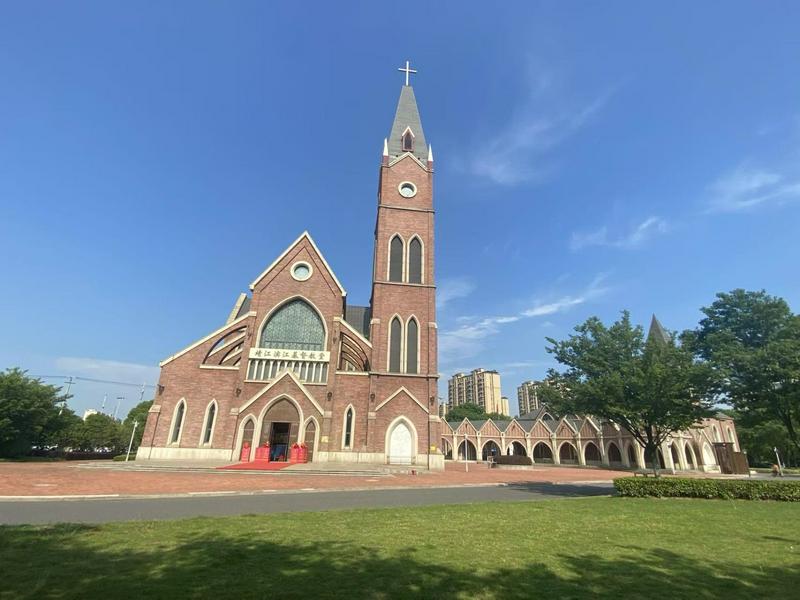
In Jiangsu Province, the Jingjiang Binjiang Church was dedicated after eight years of prayer and noted for its red-brick Gothic design, while the Wuxi Shuofang Church celebrated its completion launch on May 10. Neighboring Zhejiang Province saw the historic Deqing Fatou Church complete its new building, continuing a century-old legacy.
In Shandong, a traditional stronghold of Christianity, several churches, including the Huaien Church in Jining's Taibai Lake New District and the Bo'ai Church in Caoxian, held ceremonies. Back in Fujian, aside from the Tulou church and Shexing church, the Xiapu Xinan Church also held its consecration liturgy.
Moving north, the Jiefang Road Gospel Church in Dalian, Liaoning Province, held its thanksgiving service. In Central China, dedications were reported in Hubei Province, specifically the Canaan Church in Huangshi and the Qichun Church in Huanggang.
Additionally, groundbreaking ceremonies for the Zengcheng Church in Guangzhou and the Chengjun Town Gospel Church in Yulin, Guangxi, point to projects that will come to fruition in the years ahead.
Taken together, these dedications point not only to new buildings but also to long processes of waiting, negotiation, and perseverance. Behind each ceremony lies a congregation that has navigated change over years—sometimes decades—until a permanent place for worship could finally take shape.
In 2025, these completed projects marked moments of arrival, where faith that had long been practiced in provisional settings was given a space to endure.