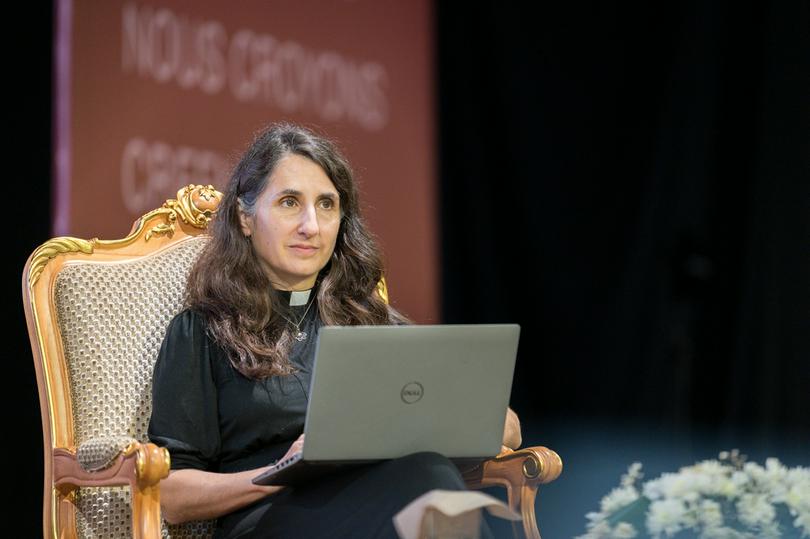
Originally from France and now residing in the United Kingdom, Rev. Prebendary Dr. Isabelle Hamley's journey is one of profound transitions—from serving as a probation officer to becoming the Chaplain to the Archbishop of Canterbury from 2017 to 2020, and now leading as the principal of Ridley Hall in Cambridge. She is also the Anglican representative to the World Council of Churches' (WCC) Faith and Order Commission. Her work consistently bridges the gap between deep academic scholarship in the Old Testament and the practical, often messy, realities of national church leadership and global ecumenism. In this exclusive interview with China Christian Daily, she reflected on the changing face of the Church of England, the "costly" work of reconciliation, and her vision for the next generation of Christian leaders.
China Christian Daily: What were your main responsibilities in the role of the Chaplain to Archbishop Justin Welby?
Isabelle Hamley: As the Chaplain, I was responsible for the pastoral care of the archbishop, his family, and the people who lived at Lambeth Palace. As there were three services every day, often with many visitors, I oversaw the liturgical and theological ministry of the Archbishop. I advised Welby on theology, particularly his sermon writing. I conducted extensive research into the thinking around theological matters because his ministry was wide-ranging. The area could be theology of disability and theology around mental health. We did a piece of work on war and how we understand war conflicts in contemporary work in the light of the Christian tradition. Sometimes my work was also linked with the House of Bishops or theologians.
I also took his publishing commitments and worked with the Community of St. Anselm, in which young people take a year out of their normal life from all around the world to come and pray, study, and work together.
China Christian Daily: Could you share an example of a moment during your chaplaincy that deeply shaped your understanding of leadership or faith in public life?
Isabelle Hamley: Being the leader of the Anglican Communion is very difficult because the needs and cultures of Christians in different parts of the world are different. It's difficult to hold everybody together because no matter what you say, it may be right for that country, but not for another.
I think Archbishop Justin managed that by being very highly relational. He spent time going to different parts of the Communion, getting to know other archbishops and bishops there, and meeting ordinary people. For me, leadership isn't just about concept or understanding with your mind, but getting to know people and building a thick web of strong relationships, which means you can talk about the stuff that makes you different in a better way.
When all our bishops come together in Canterbury for the Lambeth Conference, there are divisions in the Anglican Communion, and many disagreements over issues like sexuality. But I think because the archbishop had done so much work that was relational—like, "I want to understand your context and show that we care"—that helped. The conference was primarily oriented around enabling people to listen to one another and understand one another. That was also part of his leadership politically in terms of moving away from a colonial model to try to have much more equality between different voices from all around the globe. Unlike at previous Lambeth conferences, the archbishop had less space for himself and made more space for people from all over the world to speak and share.
China Christian Daily: The Archbishop often emphasized reconciliation and unity. How did theological reflection and prayer support that work behind the scenes?
Isabelle Hamley: I think reconciliation was central to Archbishop Justin's ministry long before he became the archbishop. He had done a lot of work in Nigeria and in various other places. He was a canon at Coventry Cathedral, where there is a specialist ministry of reconciliation, called the Cross of Nails Network.
Theologically, for him, it's profoundly shaped by the ministry of Jesus: the work that Christ did was the work of coming to reconcile all things to God. The sense of reconciliation being sacrificial was important to the Archbishop. It's costly as well. He often said that working in reconciliation is to "turn yourself into a bridge, and bridges get walked on." You can only enable reconciliation if you're fully able to understand and inhabit the mindset, imagination, and feelings of both sides, but that means that you feel like a traitor to both sides because you can understand the "other."
China Christian Daily: From your experience at Lambeth Palace, what do people often misunderstand about the Archbishop's role—both within and outside the Church?
Isabelle Hamley: People misunderstand profoundly what the Archbishop is because they think it's a little bit like a pope, and the Archbishop doesn't have the power that a pope has. The Church of England is made up of independent, autonomous dioceses, just like the Communion is made up of autonomous provinces. He has no authority over any of the other archbishops or even the bishops in the Church of England; he cannot say, "This is what we must do or believe, and you must follow." The Archbishop can only lead relationally by consensus by drawing people together, but doesn't have the power to make things happen. People often misunderstand the church as if it were a professional organization with the archbishop as the CEO at the top, and it isn't. He is the spiritual leader and the figurehead, representing the Communion, but he cannot tell them what to do or what to think.
China Christian Daily: Can you introduce us to the newly appointed Archbishop Sarah Mully? How do you think she will lead the Church of England?
Isabelle Hamley: Obviously, Sarah is the first woman in the post, but I don't think she was elected because she was a woman. She was the bishop of England, the biggest diocese in the Church of England. She worked as a nurse for six or seven years, so she has been shaped by the caring profession. She is quite pastoral and cares about people, so I think she cares deeply about the Church of England.
Archbishop Justin was focused on the Anglican Communion and the international scene. I think Sarah will be slightly less focused on the international level and have more focus on the Church of England. Just like Archbishop Justin, she comes from a senior managerial position, which shapes them both. Like Justin, she's not a theologian, so both of them are different from Rowan Williams in that sense. She's not a writer either. She's a person who acts and who does a lot to deal with systems, but is motivated by a profound care for people.
China Christian Daily: After leaving the chaplaincy for the Archbishop, what was it like to assume a theological advisory role within the Church of England?
Isabelle Hamley: The Church of England has a committee of theologians and bishops who work together to advise the rights of bishops on matters of ecclesiology and ecumenism, but also in areas that are controversial or difficult in the church today, like sexuality or the seal of the confessional. The latter refers to the fact that when someone goes to confession and expects complete confidentiality, there are many debates as to whether you should continue or whether you should be able to disclose something to the police if a child is at risk. We had done work around the theology for confession, but also confidentiality, not just in law, but theologically.
I also worked with our communications team on how we shape communications for the wider public, theological communication, and even day-to-day social media things. We had done work on theology for the environment, around governance, and the way we organize figures. They are the decisions we make about how to spend our money and how to structure our lives. Theological decisions talk about how we understand ourselves, our relationships to God, and our duties and responsibilities as Christians.
China Christian Daily: What is the role of serving as the Anglican representative to the WCC's Faith and Order Commission like?
Isabelle Hamley: As a member of the Faith and Order Commission of the WCC, I'm one of the co-chairs of one of the three working groups at the moment. We're working on decolonization and questions of justice, peace, and reconciliation. My role in the working group is to enable a conversation and exploration of those theological matters to understand their meaning in different contexts, because there are theologians from all over the world.
It's also about saying what it means for us to be Christians together. We talk about visible unity as part of ecumenism, but visible unity can not just be about sharing the Eucharist or worshiping together; there has to be something visible in our lives, in injustice, inequality, and conflict between nations, that damages our unity as well.
China Christian Daily: What were your takeaways from the Sixth Conference on Faith and Order held in Egypt in late October?
Isabelle Hamley: I really enjoyed the worship together. It was beautiful to have worship from many different parts of the world. My main reflection is that it's much better to do theology together in person than in writing across continents. You understand other people much better if you're sitting together with them rather than just writing to one another or even doing Zoom meetings.
The WCC is becoming more representative of the world as a whole, as there are more Christians from global majority heritage, from more nations, and from more denominations. But the more you have new people and new denominations coming in, the more it disturbs some of the status quo. That's always a little bit uncomfortable, but it's a good discomfort.
The WCC is a bigger organization with new members that are bringing new things, new questions, and new ways of being, and trying to work out the future. Ecumenism needs to change in response to global challenges.
China Christian Daily: You have written on violence, justice, and moral complexity in the Old Testament. What do these texts offer to churches facing conflict and trauma today?
Isabelle Hamley: Meeting people is important. Christianity is profoundly incarnational: we worship a God who was made flesh, came to be with us, and to be like us. In living a Christian life, we have to understand people as incarnated in a kind of time, space, and culture. I often fear that our world today is working hard to disincarnate human beings, to make us virtual people, to put us online, but also to turn another person that we might disagree with or see as a threat into a concept and a projection of fears and the things we don't like, rather than us meeting them as fellow human beings who are both loved by God and forgiven by God. We can only seek justice from that point of view of equality under God, and recognizing one another as full human persons, and moving beyond prejudice and caricature of the other. I think that's easy to say, but hard to do in practice.
For example, it's easy for us to reduce the humanity of a person who is termed a criminal to just the label. They're a criminal who's hurt somebody else, but we don't see that they might be a son, a brother, or a friend. However, there are reasons why they became criminals. That doesn't mean we excuse them, but being able to understand the level of responsibility that society, structures, and circumstances bear in their journey is important to find true justice: how much was the decision of that person involved, and how much were they shaped by the decisions of others? In the eyes of the people I work with in the criminal justice system, they are criminals, but they are also victims.
The church can help by continuing to proclaim that every person is made in the image of God, regardless of how deeply buried that image is. That's a redemptive work of Christ, which is to bring out that image of God again, even when it has been marred and disfigured.
China Christian Daily: Could you please introduce Ridley Hall to us?
Isabelle Hamley: It's an Anglican college with a slightly more Evangelical tradition, but not in a way that Americans use the word "Evangelical." We take in people from all Christian denominations and put emphasis on spirituality and theology, but we're linked to the University of Cambridge, so we offer both Cambridge degrees and the degrees via the University of Durham. We have a strong biblical studies department here, and we train people for ordination, but we also train people for all kinds of other ministries, such as lay ministry, ministry with children and young people, and also independent students. Particularly, we train people who are going to be chaplains in sports centers and for football teams because the life of an athlete is often a difficult life. Many young people engage in sport, so it's a way of reaching across many different social classes.
China Christian Daily: How do you see theological education evolving in response to the changing context of ministry in the UK and globally?
Isabelle Hamley: Many questions around theological education are now about: What is theological education for? What do we do when we train people? Do we just fill their head? What's the point of theology?
I think education in the United Kingdom is becoming more utilitarian, but teaching theology isn't just about something being useful today; it's about shaping people's minds, shaping their character, and enabling them to see the world through a different set of lenses. It's a long-term and more difficult work. We're constantly having to try to explain that the work we do is not just about practical skills.
Particularly after COVID, many people are less willing to come up for ministry, and they're less willing to make sacrifices. People put their mental health and family first, so we need to fight individualism of Western nations because individualism is trying to push everybody to study on their own and for their own sake, rather than understand that theological education is about the whole church together to discern the mind of God and our becoming shaped by being in relationship with one another.
There's also increasing openness to the wider world in theological education. I'm trying to find a balance between listening to theologians from everywhere and helping people be shaped for ministry in the context in which they will find themselves.
I hope that we can continue shaping people who are Spirit-filled and Christ-centered, and who will continue to reflect on how to speak of the gospel for today.
China Christian Daily: As a principal, what is your vision for forming the next generation of Christian leaders?
Isabelle Hamley: Our vision is to help them develop wisdom. Wisdom is a good biblical concept about having deep roots in the story of the church and understanding where we have come from and on what God has given us, together with the ability to be created and faithful in thinking: how do we need to do things slightly differently for today? How do we think creatively about what church will be like tomorrow? The UK is becoming more and more secular, so the church needs to adapt how we tell our story, but you can only do that if you have very deep roots. Wisdom is about the ability to put together our roots and our creativity for the future.
China Christian Daily: Your journey spans parish ministry, biblical scholarship, national church leadership, and theological education. Looking back, what has remained constant in your sense of calling?
Isabelle Hamley: One of the things that has remained true throughout my calling is that God is always ready to surprise us. But often, when we think we are called, we go and do the things we want to do. If you're attentive, you see that God is at work in ways and in places you did not expect. There is a sense of needing to be open to the work of God in unexpected places.
Wherever I have been, my love for people has probably been strong. I always have a sense of the importance of connecting with people and listening. Leadership is partly about the ability to think about the whole, but hold the person as part of the whole. You can't forget the importance of persons just because you're looking at the big picture. But equally, you can't get lost in the person and forget the big picture. That's probably been a constant tension, but also an important thing in leadership in every context.
China Christian Daily: What blessings do you have for Christians in China? Have you ever been to China?
Isabelle Hamley: I have never been to China, but I would have loved to have been to China. I do know many Chinese Christians, particularly Christians who became Christians in the UK when they were studying.
What I hear from the church in China is that it's quite big and vibrant. I would love to know more. I would love to read more Chinese theologians translated into English because I can't read Chinese. We need the church in China as part of the church as a whole.
Chinese Christians need to have a voice in the WCC and in other places because we need every part of the body of Christ. If not, we're missing a perspective, part of our understanding of God. I would love the voice of Chinese Christians to be heard more, but it's not always easy. I would pray for you to keep being witnesses, to follow the gospel, and to reflect the love of Christ for your labor every day.