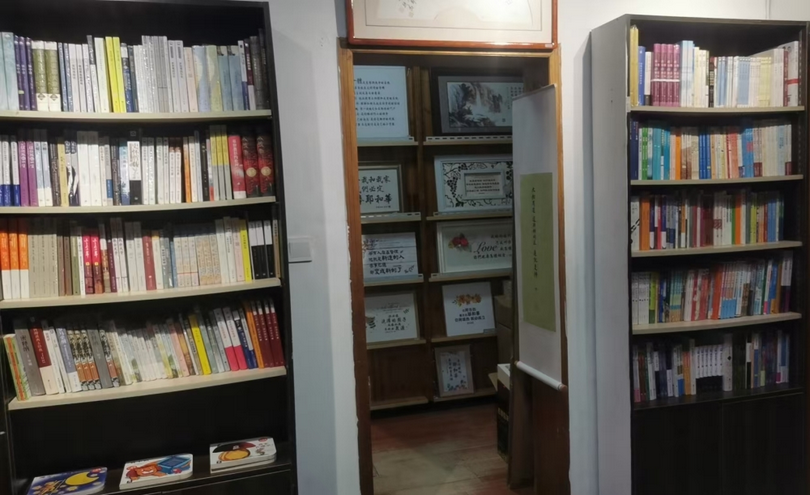
By chance, Brother Wang Shutong, who had served as a volunteer at his church for more than a decade, passed by a Buddhist supplies shop. Looking at the various items on display, a strong thought surged in his mind: he wanted to open a Christian shop. He spent about seven or eight years in research and preparation and finally took over a Christian bookstore.
He chose to retire early from a well-paying job simply to run his bookstore. After taking over, he rented the neighboring storefront, doubling the shop's space.
Now, Wang has been running the bookstore for 10 years. He state that he has welcomed people from all walks of life over the years, from university students eager to learn to highly educated volunteer preachers who bought books by the bagful. Yet he noticed that full-time hardly ever come and buy books.
Beyond his role as a bookstore owner, Wang also serves as a committee member of a church with a history spanning more than a century. Bearing this dual identity in mind, he sketches a picture of the bookstore's clientele and reflects on the state of pastoral care in the church.
Recently, I visited this bookstore, where Wang shared its history and offered a glimpse into its everyday life.
The Knocking
This Christian bookstore is in a culturally rich city in the south of China. It is surrounded by well-known hospitals and universities. It sits on the edge of a busy intersection, with a slope in front, a residential area behind, and tall office buildings on the sides. Amid the hustle and bustle, tucked under some large phoenix trees, the bookstore brings a rare sense of calm.
Wang really likes this location, which matches perfectly his initial preference for how he wanted to preach the gospel. In the early days, he hired two staff members to work in shifts from 8:30 am to 9:30 pm. He said, 'When the busy crowds pass by in the morning, I want them to notice that a Christian bookstore is nearby. In the evening, when the lights of the surrounding office buildings go out, I want people to see that there's a shop with colorful lights on at the street corner.'
As hoped, many non-Christians come to his bookstore, with college students being the main group. The students usually buy books on psychology, sociology, philosophy, Christian history, and even some theological works for their studies. Their majors range from religious studies, literature, philosophy, and history. Many senior students would recommend the shop to new students before graduating.
Whenever he establishes trust with the students, Wang will directly suggest they attend church services: "Your professors explain Christianity from a cultural perspective, but if you want to understand the core of faith, you need to go to a church." Wang admits that he cannot minister to these young people himself and can only recommend them to a church. Whether the church could hold them, he is not sure about it.
Besides knowledge seekers, there are answer seekers of practical issues in everyday life. Once, a non-believer discovered books on marriage and family in his store. That customer was as happy as if he had found treasures. He deeply relates to such seekers. Before coming to Christ, he once heard a relationship expert on midnight radio advocating for "sex before marriages" and "tacit approval of extramarital affairs." At the time, he felt it was wrong but could not explain why. After becoming a Christian, he found a clear view of marriage: "one man and one woman, one husband and one wife, for a lifetime." To promote a healthy perspective on love and marriage, he even had these Chinese characters printed on a big red banner and put it in front of the bookstore.
Some people just come in to stay there, and Wang treats them equally warmly. He has listened to a young man talk about his work and family conflicts for over two hours. There is also a person with mental issues who comes regularly, and the bookstore always serves him a cup of hot tea.
While I was talking with Wang, a lady came in with her elderly mother to ask about some books. The mother was interested in church-internal materials, but the bookstore could not provide them. Wang patiently explained how they could get them through official channels and encouraged the daughter to go to church.
The Simple Needs of Ordinary Believers
Compared to seekers who explore across principles, the needs of ordinary believers are specific and simple: Bibles, hymns, and a few easy-to-understand meditation or self-study books.
When ordinary believers come to the store, he often introduces them to different kinds of books. Although most of them will not buy anything, he knows that at least his introduction serves as general information to them.
Even though purchases from ordinary believers are low, many of them have developed deep friendships with this bookstore. An elderly female believer who lives above the store used to come around in the afternoon to read the Bible. She stayed for over an hour each time and kept doing this for up to five years. She has a son who suffered a major setback and developed a mental illness. Wang and the bookstore staff have accompanied her to visit him, and later the son came to believe in Jesus. Her daughter also became a Christian and now works voluntarily for a church.
Apart from elderly believers, young parents with children are also regular visitors. To raise devout children, they choose parenting books like Positive Discipline. Books as such are suitable for parent-child reading, for example, The Bible History Told to Our Children, and children's picture books that contain Christian values. Wang feels a sense of regret toward this group. He hopes to set up a cozy parent-child reading corner in the bookstore so that children have space to play and read, but unfortunately, that has not happened yet.
The needs of ordinary believers may seem simple, but it is not easy for the church to meet their needs. Wang believes that pastors should communicate more often with believers to understand their situations, explain profound truths in a simple and understandable way, and help them apply these truths to their practical lives.
The Main Buyers: Seminary Students and Highly Educated Volunteer Pastors
Seminary students often come in groups. Sometimes they look for specific books, and other times they stop by when they are out in the city. Visiting seminary students from other cities to local seminaries or churches also stop by as a must.
Whenever such groups arrive, the bookstore, which is less than 100 square meters, becomes lively at once. Curious passersby often stop to see what is going on or simply come into the store. That unintentionally fulfills Wang's hope of attracting non-believers to learn about Christianity.
About the buying preferences of seminary students, Wang concludes, "They like to buy biographies of well-known Christians, as well as books on sociology, psychology, and biblical exegesis. They also like creative Christian gifts." When they find their favorite books, they sometimes buy another copy as a gift to someone even if they already own one.
Compared to seminary students who are still studying, highly educated volunteer pastors have stronger purchasing power.
In churches, there are usually only a handful of full-time trained ministers. So how can they pastor congregations of hundreds or even thousands? Volunteer preachers play a very significant role. Among these volunteers, many hold bachelor's, master's, or even doctoral degrees from universities. They are the major customers.
Reference books are their priority to enhance their preaching skills: annotated Bibles such as the Chinese Study Bible, Devotional Bible, and the Reference Bible, sermon collections, exegetical works, and so on. They comprehend and organize these materials first. Then they share them with their congregations, sometimes combining social knowledge with faith in fresh and eye-opening ways.
Missing Footsteps: Pastoral Concerns for Full-Time Ministers
As for full-time ministers, he has a sense of helplessness, "They hardly come to buy books. In fact, they need to get out and broaden their horizons." Wang added that only three full-timers have ever visited the bookstore, and they are seminary teachers.
Drawing on his nearly thirty years of volunteer service in the church, he points out two reasons for this: on one hand, the tedious administrative tasks and frequent meetings consume much of full-time pastors' energy, leaving them little time to read; on the other hand, some pastors feel that after systematic theological training, their knowledge is sufficient and thus lack the motivation to continue learning.
"If pastors stay in a closed circle for a long time, it's easy for them to fall into self-satisfaction," Wang said frankly. "When believers come with simple questions, and they can answer them without thinking, they gradually become complacent."
This kind of stagnation brings a severe pastoral crisis, which unintentionally drives thoughtful young people and intellectuals out of the church. If this continues, even elderly believers may grow bored from not learning anything new.
To attract intellectuals to learn about Christianity, Wang once held a tea gathering at the bookstore. He invited instructors from institutions and a Buddhist colleague. As for Christian attendees, he did not invite full-time pastors but a Christian professor. He thinks that when talking with intellectuals, you cannot just indoctrinate them; you must let everyone express their views. Then, based on what the other party is willing to discuss and can easily understand, he introduces the Christian perspective.
Wang particularly hopes that the church can arrange retreat time for full-time pastors, so they can be free from trivial matters and recharge calmly. However, compared to these institutional changes, a more realistic concern might be whether they are willing to open the door that connects them to the bigger world.
("Wang Shutong" is used as a pseudonym for safety reasons.)
- Translated by Charlie Li
Originally from the Evangelical Vision
CCD edited and translated with permission