As December approaches, the sights and sounds of Christmas begin to fill the streets. Yet, for Christians, this season is about more than just decorations and gatherings; it is a profound spiritual moment that declares: "Hope has arrived."
Advent, the first season of the Church's liturgical year, quietly unfolds amidst the noise. But many believers may wonder: Why do we celebrate this season? What spiritual expectations does it hold?
The History of Advent
This year, Advent begins on November 30, 2025, marking the first Sunday of the liturgical year. The Christmas cycle typically includes three seasons: Advent, Christmastide, and Epiphany. Advent specifically encompasses the four Sundays preceding Christmas Day.
The origins of Advent date back to the late 4th century. It was originally a forty-day period known as "St. Martin's Lent" (starting November 11). By the 7th century, the season was shortened to four weeks, forming the tradition we observe today.
The English word "Advent" comes from the Latin Adventus, meaning "Coming" or "Arrival." It points to the coming of our Savior, Jesus Christ. Spiritually, Advent invites us to look back at how Old Testament prophecies were fulfilled in the New Testament, while simultaneously preparing our hearts in the present to welcome the "Word made flesh."
Historically, Advent was a season of penance and fasting, similar to Lent. Early Christians would fast, abstain from festivities, and focus on prayer. Over time, the nature of Advent shifted from strict fasting to a spirit of joyful hope. Today, especially in the Evangelical and Catholic traditions, Advent emphasizes a dual hope: celebrating Christ's first coming at Christmas and awaiting His second coming in glory.
Symbols and Traditions of the Season
Along with its history, Advent brings rich traditions that symbolize hope and preparation.
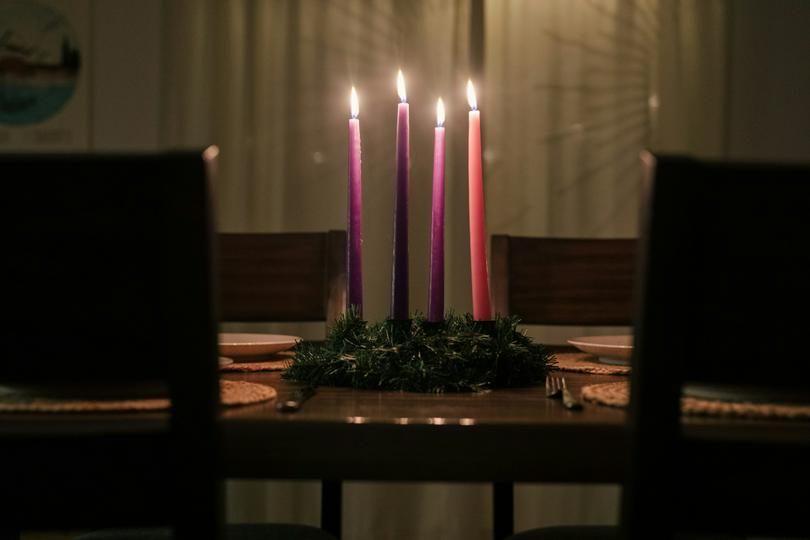
The Advent Wreath: The most iconic symbol, often found in churches and homes. The wreath is made of evergreens, symbolizing eternal life, while its circular shape represents God's infinite love. It holds four candles, lit each Sunday successively. The increasing light symbolizes the approach of the True Light.
- Three Purple Candles: Represent penance, waiting, and royalty.
- One Rose (Pink) Candle: Lit on the Third Sunday (Gaudete Sunday), representing Joy.
- (Optional) Center White Candle: Lit on Christmas Day to represent Christ.
Liturgical Colors: Purple (or Violet) is the traditional color of Advent, signifying repentance, preparation, and the sovereignty of Christ. While some modern traditions use Blue to emphasize hope, Purple remains the primary color in Catholic and many liturgical traditions.
The Christmas Tree: Historically, the evergreen tree points to everlasting life. The lights symbolize Christ as the Light of the World. Ornaments, evolving from apples placed on trees in medieval mystery plays, remind us of the fruit of Eden and the necessity of salvation.
Family Activities: Many families use Advent Calendars to help children count down the days with scripture or prayer. Furthermore, Advent is a season for Charity. We are encouraged to turn our faith into action, bringing Christ's love to those in need.
Preparing Your Heart: Four Weeks of Advent
Beyond the decorations, the true work of Advent happens inside us. Each of the four Sundays guides us closer to the birth of Christ through specific spiritual themes:
Week 1: Hope and Watchfulness. In the flood of daily pressures—work, bills, and uncertainty—we often focus only on what is visible. The first week calls us to stop and ask: Am I still waiting for the Lord with hope? This is not a naive optimism, but a conviction that Light will penetrate the darkness. We are called to stay awake spiritually, not letting the world numb us, but expecting Christ to work in our daily lives.
Week 2: Faith and Repentance. True repentance begins by confronting our pride. We may say we trust God, yet we often rely on our own plans. Advent reminds us to honestly face our selfishness and indifference. Repentance is more than regret; it is action. It is repairing relationships, adjusting our behavior, and allowing God to reshape our hearts.
Week 3: Joy. On the third Sunday, we focus on Joy. We are often exhausted, thinking happiness comes from external circumstances. Advent teaches us that true Joy comes from God's presence. Even amidst difficulties, the reality of His coming warms our hearts. This joy is a deep, inner peace that sustains us even when life is hard.
Week 4: Peace. As December ends, we may feel anxious about unfinished goals or the coming year. The world gets louder as Christmas nears, but our hearts need quiet. The peace God gives does not mean the absence of trouble, but a sense of security amidst the storm. We are invited to let the "Prince of Peace" rule over our anxiety and grant us strength for the new year.
As the four candles of the Advent wreath are lit one by one, we are reminded that the True Light comes not from city decorations, but from the Savior who entered human history.
In this busy December, may we not be drowned out by the noise of the festivities. Instead, let us pause, quiet our souls, and allow Hope to rekindle, Faith to take root, Joy to overflow, and Peace to fill every corner of our lives.
Advent leads us to look back at the manger in Bethlehem, look forward to future glory, and experience His presence right now.
May we spend these four weeks with prepared hearts, ready to welcome the King of Peace.