
Editor's note: Ankang Museum in Shaanxi Province houses a unique collection of historical artifacts donated by the family of Rev. Johan T. Johansen, son of a Norwegian missionary to China. China Christian Daily recently conducted an exclusive interview via written correspondence with Rev. Johansen. The following feature story brings his firsthand memories, chronicling a century-long bond of faith and friendship between Norway and China.
In the grainy yet vibrant footage, a young boy walks alongside Pastor Gu on the road to Nanba. Later, in Hengkou Town, the same boy—young Johan—can be seen curiously reaching out to touch the long noodles hanging out to dry.
These moments are frozen in time, preserved in the documentary "Color Old Ankang (1947)". It is the first color documentary filmed in China, shot by Norwegian missionary Karl Mortensen using a Kodak 16mm camera.
According to his diary, Mortensen wished to document society exactly as it was. He captured people at work, the natural landscape, and church life—all to ensure that Christians in Norway might gain the best possible understanding of conditions in China in 1947.
Decades later, the boy in the film returned to the city of his childhood, bringing the precious reels with him.
"This film is taken with love to the Ankang people, and it is with love we have given it back to Ankang!" Rev. Johan T. Johansen told China Christian Daily in an email.
Growing Up in the Mission Field
Johansen spent nearly a decade of his childhood in Ankang, having arrived at the age of two.
His father, Rev. J. Tidemann Johansen, served as a missionary for the Evangelical Lutheran Free Church of Norway (Frikirken). The Free Church, founded in 1877, initially supported other organizations in overseas missions. By 1914, however, the church decided to launch its own work in China. In 1918, missionary O.A. Sommernes arrived in Ankang, Shaanxi, becoming one of the first pioneers to reach the region.
Rev. J. Tidemann Johansen arrived in 1928 to assist Sommernes. In 1937, the family returned to Norway for a furlough, where young Johan was born the following year. Despite the outbreak of World War II, the family chose to return to Ankang. They continued their work in medical aid, education, and evangelism amidst the turmoil of war until they left China in 1949.
These historical currents shaped Johan's life trajectory. His childhood was spent in the alleys of Ankang along the Han River, witnessing his parents' dedication firsthand.
"My mother and father worked in the church and took me along in much of what they did," Johansen recalled. "My father often rode his bicycle, and I was allowed to sit on the bar when he visited many homes, both in the city and in the countryside."
From Childhood Memory to a Personal Calling
After returning to Norway and finishing secondary school, Johansen attended a Christian college. For him, "missions" was not a distant concept but the norm of his upbringing. Yet, he struggled to discern whether his desire to serve was merely out of admiration for his parents or a genuine calling from God.
One day, the veteran missionary O.A. Sommernes visited and took the young student aside. "Johan," he asked directly, "have you thought about becoming a missionary?"
"I don't know," Johansen answered honestly. "I've thought about it, but I don't know if it's because I admire my mother and father. They always expressed joy and gratitude for being sent to Ankang, and they prayed for Ankang every day after we returned to Norway."
Sommernes replied, "Johan, you must pray to God that He will give you a concrete calling." He then shared his own experiences of danger in the mission field, recounting how he held fast to the conviction: "God, it is You who has called me here."
That conversation became a turning point. Johansen enrolled at the MF Norwegian School of Theology in Oslo, where he studied for seven years. One day in the fourth year, while he was praying in the prayer room, God spoke clearly to him that He wanted him to give his life in missionary service.
That very afternoon, he was traveling to Moss to congratulate Sommernes on his 70th birthday.
Upon arriving, Johansen approached the old missionary. "Sommernes, I am a poor student, so I haven't bought you any gift," he said. "But I must tell you that today I received a clear calling from God that He wants me to be a missionary."
Sommernes took him by the hand and led him into his office, leaving the other guests behind. There, he prayed to God for the young successor.
From Private Artifacts to Public History
Johansen went on to serve for 17 years in Taiwan, then 17 years in a church in Norway, and five years as a mission secretary.
Following China's opening up, the Free Church reconnected with the mainland. From 1983 until 2019, Johansen traveled to China every year.
"It has always been strengthening to my faith to meet the many elderly pastors on my journeys," Johansen wrote. "Their testimonies of what life has been like for them and their zeal for building God's kingdom have made a big impact on my life. They carried with them an experience of what it costs to be a servant for the Lord."
He recalled a worship service in Fuzhou in October 1983, where both the church and the square outside were packed. For a missionary family that had left in the late 1940s, seeing the faith not only survive but thrive was profoundly moving.
During his travels, he also spoke with Bishop K.H. Ting, a prominent Chinese church leader. When asked about the challenges facing the church, Bishop Ting replied: "There are many great challenges that we as a church face today. We meet each one of them in faith to the Holy Spirit and ask for wisdom and power to meet the challenges and resolve them, so it strengthens the church and blesses the Christians."
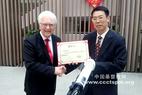
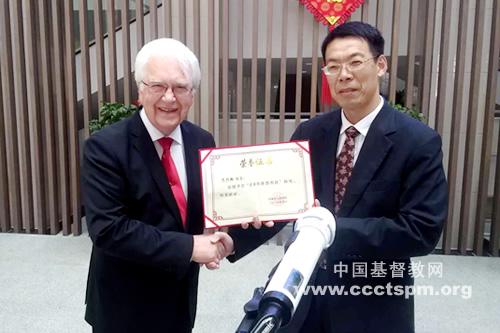
Through these visits, Johansen contributed to renewing the friendship between the churches of Norway and China. This renewal was symbolized by his donation to the Ankang Museum.
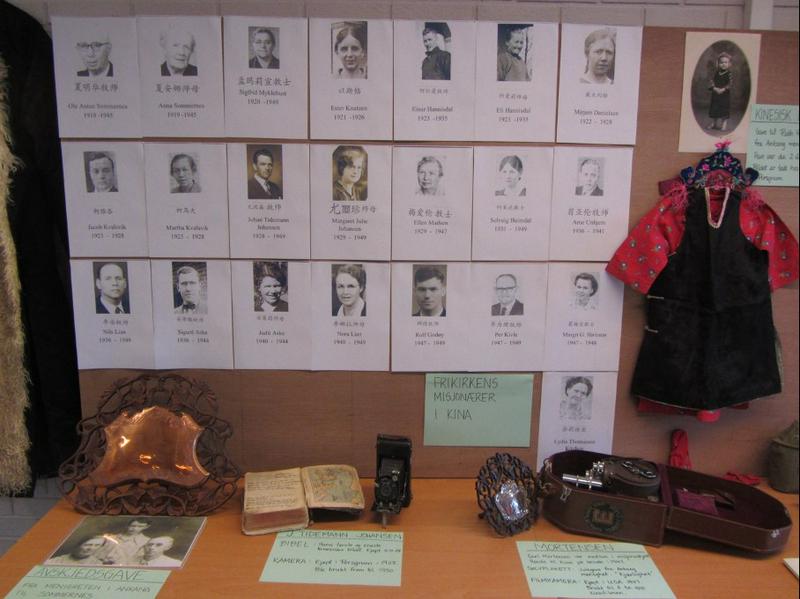
The donation included not only the rare film reels but also hundreds of photographs taken between 1918 and 1949 by Norwegian missionaries, his father's camera, the camera Mortensen used for the color documentary, and a Chinese dress his sister received as a toddler.
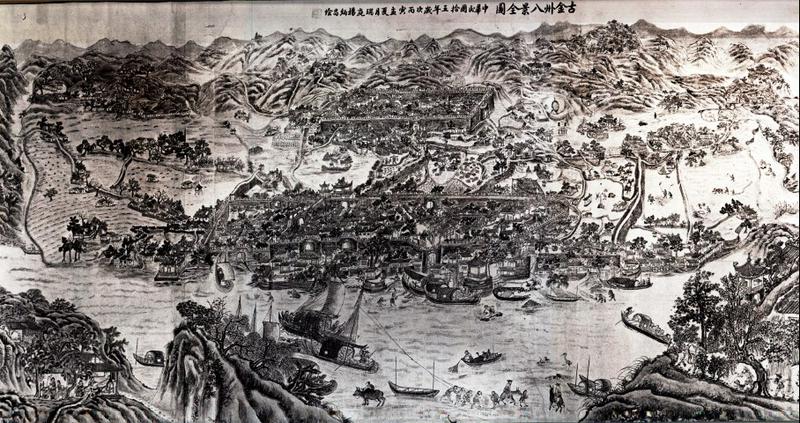
Of particular historical value is the "Map of Eight Views of Old Jinzhou." Painted by Yang Bingchang in 1926, it depicts the new city walls completed after 1583, the embankments, and the expanded old city of Ankang from the mid-Qing Dynasty. This precious cultural heritage had hung in Johansen's living room in Norway for decades.
In his email, he described the donation as a return filled with love. "All these different items that I brought with me to Ankang are an expression of what we thought and felt about the city. All of us who grew up in Ankang have a strong and deep love for the city. To see the city's development brings us great joy."
A "Sister Church" Bond
Over his many years of visiting, Johansen has introduced many Norwegian friends to China. Some years ago, representatives from the church in China also visited Norway.
"If we are to build relationships with one another, we must meet and have contact. We must see each other, visit our churches, and learn about the different tasks and challenges each one of us faces. This will also lead us to pray for one another," Johansen wrote in reply.
Today, the Free Church has grown into a community of 79 congregations, operating Bible schools and two colleges. Its focus remains on building a spiritual home for the whole family.
The church's global footprint has also expanded. Building on the legacy of its work in China and later in Taiwan, Ethiopia, and Mali, the church is now actively involved in missions in Japan and the Middle East.
Despite this global reach, the bond with Ankang remains special. In Johansen's church in Norway, they pray every Sunday for the church in Ankang. They call it their "sister church."
"I know that our sisters and brothers in China also pray for us here in Norway," Johansen wrote. "By continuing the contact both ways, praying for each other, we hope that new generations will carry on our relationships to the glory of God's Kingdom."