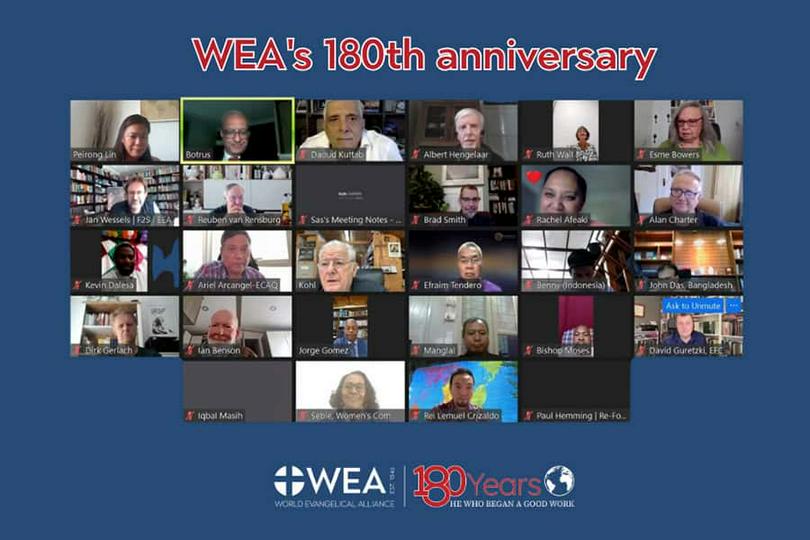
The World Evangelical Alliance (WEA) marked its 180th anniversary with a global online celebration on Sept. 23, tracing its history from a gathering of church leaders in London in 1846 to a new initiative aimed at 2033. Dr. Peirong Lin, the WEA's chief of staff, hosted the program, which moved through three themes: the past, the present and the future.
Opening the celebration, WEA Secretary General Rev. Botrus Mansour welcomed participants on behalf of the WEA's International Council, nine regional and 164 national alliances, church networks, commissions and "thousands and thousands of people." The gathering took as its theme Philippians 1:6, on God completing the work he has begun, and used it to structure the program: history, present ministry, and vision for the future.
From London to a Global Family
A video traced the alliance's history through the voices of five of its own former leaders: Agustin "Jun" Vencer, Geoff Tunnicliffe, Bishop Thomas Schirrmacher, Dr. Goodwill Shana and Bishop Efraim Tendero, who each reflected on what the WEA had accomplished under their leadership, from launching its work at the United Nations to defending religious liberty and expanding its global media presence.
Rev. Dr. Chris Wright, international ministries director of the Langham Partnership, brought greetings on behalf of All Souls Church in London, the home church of Langham's founder, John Stott. He said Stott "became very much part of the history of it, very supportive of it, very much involved with the theological work that the WEA has done over the years."
Dr. Brian Stiller, the WEA's global ambassador since 2011, gave the keynote on the alliance's history and its present significance. He traced the alliance's founding to the momentum of the era's evangelical awakenings and William Wilberforce's campaign to end slavery in the British Empire, saying church leaders were looking for a way "to channel the energies of an awakened church into something that could endure."
He described the 1846 London founding as a group of Protestant leaders choosing, in his words, to stand together "on what they held in common" rather than erasing their denominational differences. He put the WEA's current network at 164 national alliances representing more than 650 million Christians, and said it is "acknowledged as the primary representative voice for roughly one quarter of the world's Christians" at bodies such as the United Nations.
Stiller was candid about the alliance's constraints. He said the WEA "operates on what I can only describe as a shoestring," since its work is less visible than that of relief or Bible-distribution agencies, and said its governance faces an inherent tension between representing 164 diverse national contexts and moving with strategic clarity. He also pointed to the shift of the global church's center of gravity toward Africa, Latin America and Asia as a reason the WEA's role remains necessary.
A Family at Work Today
The second part of the program turned to the WEA's current ministries. Dr. Brad Smith, interim director of Alliance Engagement, said the WEA's national alliances span 164 countries, supported by nine regional alliances and a crisis response coordinating center that channels donor funds to local churches for disaster relief.
Rev. Esmé Bowers described the WEA's commissions and networks, covering theology, missions, women, youth, children, family and generosity, as bodies that study what God is doing in a given area and equip national alliances with resources. Dr. Kyle Wisdom, on global advocacy, said WEA teams in Geneva and New York engage the United Nations year-round, citing as an example the closure of more than 10,000 churches in Rwanda, after which, he said, "the government has accepted our recommendations and committed to amending its registration law and reopening them."
Dr. Peirong Lin noted that the WEA also brings together more than 100 affiliate church networks and Christian organizations. James Burden, the WEA's IT manager, closed the segment by unveiling a redesigned worldea.org website, organized around three themes he named as convening, connecting and advocating.
Call 2033
For the final segment, Mansour introduced a new initiative he called "Call 2033," built around three priorities he said were drawn from an earlier internal document, "Roadmap 2030": strengthening national alliances, advocacy, and collaboration. On the third point, he described a plan to match national alliances and affiliate organizations that have particular strengths in evangelism, discipleship, disaster relief, or advocacy with alliances elsewhere that have identified a corresponding need. He said the WEA has sent a questionnaire to its national alliances and affiliate members asking what they believe God is calling them to do, and that about 20 alliances have already responded. "We're not going to impose on them anything," he said. "They decide... what their calling is from God."
Dr. David Guretzki then led a prayer for the initiative, framing 2033 as the 2,000th anniversary of the founding of the church at Pentecost.
The celebration closed with a series of video greetings from a wide range of Christian bodies and other faith organizations, reflecting the breadth of the WEA's relationships. The celebration closed with video greetings from a range of Christian bodies and other faith groups, underscoring the breadth of the WEA's relationships.
Dr. Michael Oh brought greetings on behalf of the Lausanne Movement, Rev. Dr. Casely Essamuah on behalf of the Global Christian Forum, and Dr. William M. Wilson, president of Oral Roberts University and chair of the Pentecostal World Fellowship. Rev. Prof. Dr. Jerry Pillay, general secretary of the World Council of Churches, and Archbishop Flavio Pace of the Vatican's Dicastery for Promoting Christian Unity, also sent congratulations. Greetings came from outside the Christian world as well: Rabbi Mark Dratch, chair of the International Jewish Committee for Interreligious Consultations, and Kyai Haji Yahya Cholil Staquf, chairman of the Institute for Humanitarian Islam and former head of Indonesia's Nahdlatul Ulama.
Before the closing benediction, organizers also pointed viewers to a related online gathering the same day, describing it as an opportunity for "a Chinese perspective of the WEA and the growth of the Chinese church", a reference to the separate World Chinese Christianity Alliance (WCA) session also held Sept. 23.