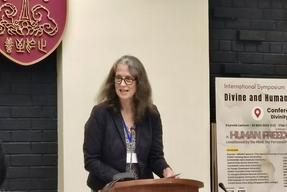
In Hong Kong, Dr. Marla F. Frederick, dean of Harvard Divinity School, discussed the school's multi-religious mission and the challenges facing U.S. higher education.
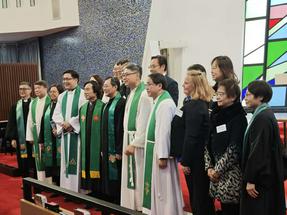
With the theme "Called to the One Hope" (Ephesians 4:4), the annual Joint Ecumenical Communion Service in celebration of the 2025 Week of Prayer for Christian Unity was held on Thursday, setting a record attendance of 390 ministers and co-workers from over 32 denominations and organizations.
Prof. Maren R. Niehoff argued that, according to Philo, true freedom requires Stoic self-discipline of the Mind, a Cynic-like independent Personality, and is ultimately realized in obedience to God.
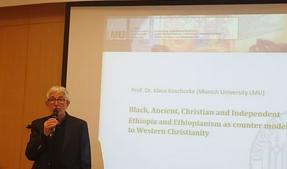
Prof. Klaus Koschorke showed that Ethiopian Orthodox Christianity existed long before European colonialism, which proved that Christianity wasn't just a European religion brought to Africa. The Ethiopian church became an important example for African and African-American independence movements.
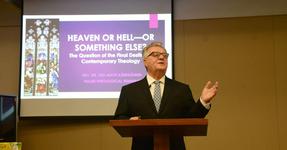
What happens after we die? Dr. Veli-Matti Kärkkäinen argued for an "optimism of salvation" which rejects both the certainty of universal salvation and traditional views of eternal torment.
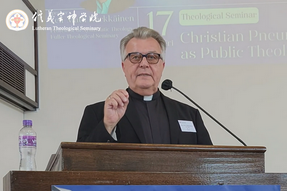
Dr. Veli-Matti Kärkkäinen argued for a "world-embracing, multi-layered pneumatology" that extends the Holy Spirit's work beyond the church into all public domains. His lecture explored the Spirit's role in society, science, and other religions, advocating for a "post-critical" engagement with these spheres.
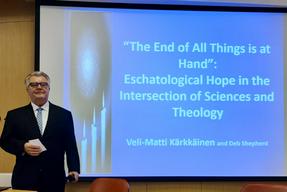
Prof. Veli-Matti Kärkkäinen delivered a lecture on the intersection of Christian eschatology and scientific cosmology. He contrasted the scientific prediction of the universe's eventual heat death with the theological hope for a divinely initiated new creation.
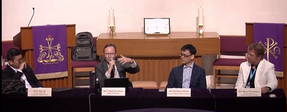
On October 17, 2025, a roundtable forum commemorating the 1700th anniversary of the First Council of Nicaea was held at the Chinese University of Hong Kong (CUHK), bringing together leaders from diverse Christian traditions to discuss the significance of the Nicene Creed.
His Holiness Mar Awa III lectured on the Assyrian Church's dynamic reception of the Nicene Creed, highlighting a linguistic shift from "essence" to "nature" and demonstrating how a universal doctrine is actively reinterpreted to address new theological challenges.