In the borderlands of Tibet and the rest of China, a small Catholic community has endured wars and rapid social change. In a largely Tibetan Buddhist region, the Chinese Catholics in the town called Yanjing have inspired admiration and hope for their resilience and steadfastness.
This enduring faith in Yanjing can be attributed in part to Mr. Lu, a Tibetan Catholic born in 1971. In 1996, after being ordained, he led the Yanjing Church through a major renovation project. After he resigned from religious office in 2007, he continued to serve as a layperson, demonstrating adaptive leadership that sustains faith amid challenges.
This article is an intimate reading of a single lengthy interview with Mr. Lu, whose life story echoes what historians of Chinese Catholicism have observed across the country, particularly the importance of families, lay leadership, and negotiation with officials. Interestingly, his personal account has been unraveling in a distinctively Tibetan setting.
His life opens a unique window into how the Catholic faith is lived, strengthened, and passed on in a place where almost everyone else is Buddhist.
Becoming Guardians of the Church
Mr. Lu's narrative does not begin with his birth nor his vocation. This extraordinary tale dates back to his grandfather.
Mr. Lu recalls his great-grandfather's son, who was "saved by a missionary" in 1919, when, by order of the Tibetan Buddhist theocratic monarchy under the 13th Dalai Lama, all foreign priests were forced to leave Tibet. Before they departed, one priest entrusted the church and the small community of believers to Mr. Lu's grandfather, imploring him to watch over the people and the property. From that point onwards, the family embraced what seemed to be their destined role as guardians of the local church.
Notably, Mr. Lu was raised by his mother alone because his father had passed away when he was born. From his childhood memories, he recalls that his family has always carefully kept some religious vessels. When he asked his mother about them, she told him they were the vessels used by the priest during mass. She also told young Mr. Lu about the historical relationship between their family and the missionaries who left at that time.
Mr. Lu further shared that other sacred objects were carefully preserved in the family home. These items included vestments and other liturgical tools, which have become tangible reminders of the bond between Yanjing's Catholic community and the wider Church. At a time when priests were unknown, these objects anchored the people's memory and identity. Importantly, these pieces reminded them that they belonged to something older and deeper than any regime or campaign.
Over time, his relatives quietly passed on the faith amid a strong Tibetan culture and Buddhist influence, and the recurring task of serving as keepers of the faith when clergy is absent fostered respect and appreciation. In this sense, the church's story is also his family's. Such fusion of church and kin would later help him—as a priest and then a lay leader—rebuild both the physical building and the congregation. For Mr. Lu, the line actually blurred between "church history" and "family history."
On a personal note, at about 15 or 16 years of age, young Mr. Lu decided that he wanted to become a priest. After graduating from high school, an elderly local nun suggested the government look for religious institutions to train priests, and on her recommendation, Mr. Lu was admitted to National Seminary of Catholic Church in China in Beijing during a time that marked a crucial period for the transition for clergy in China. Upon his graduation, he went to several churches for internships. A year later, he returned to Yanjing to take over the church.
Rebuilding, Negotiating, and Enduring
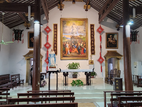
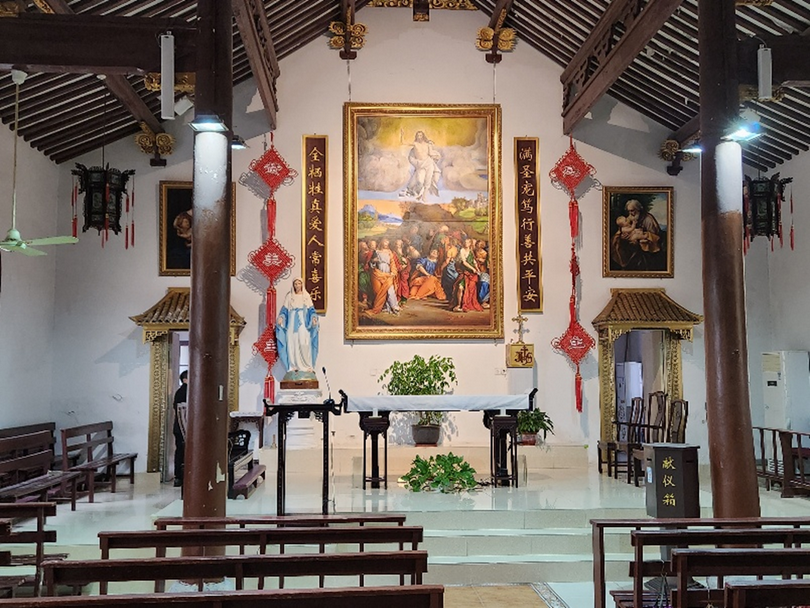
Like many Catholic communities in China, Yanjing's church building was damaged, repurposed, and rebuilt more than once in the 20th century. Mr. Lu recalls timber reconstruction in the 1980s, followed by a decision to build a new church on a different site. The completion of this "new" church in 2002 symbolizes hope and perseverance, inspiring the community's resilience.
He describes the work in very concrete terms: organizing teams of parishioners to cut timber in the mountains; traveling to raise funds; and visiting local government offices to explain, persuade, and negotiate. "I began to raise funds everywhere," he said, "[I also] mobilized parishioners to cut timber in the mountains and communicated with the government to negotiate reconstruction."
An especially striking episode involved the acquisition of three bells. Mr. Lu recounts how he obtained three French church bells through a Japanese intermediary—an unlikely chain of events he interpreted as providential. Eventually, these bells, along with the old missionary cemetery and other inherited items, became powerful symbols that tied Yanjing not only to its own past but also to the history of Catholic missions worldwide. Notably, they offered visible proof to both Catholics and non-Catholics, reaffirming the community's deep roots and its legitimate claim to be part of the Church.
Fast forward to the present, it can be said that Yanjing Church has endured because of the continued practice of its followers. One might ask, amid the ongoing changes of the times, how are regular Sundays spent among parishioners? Mr. Lu shares that every Sunday, he leads the prayers and then preaches in Tibetan. He combines the day's scripture readings with real-life experiences to convey God's will. Sometimes, he invites priests from other areas to preside, and he will cooperate with them as they visit. On special occasions, like major holidays, they also invite Buddhists to participate in the celebrations.
Despite their achievements and persistence, Mr. Lu frankly admits the church's vulnerability due to financial constraints and practical difficulties with maintenance, highlighting the ongoing challenges the community faces in sustaining its modest local church.
Living Alongside Tibetan Buddhism
For many readers, the idea of a Tibetan Catholic may be surprising. Yanjing, a small town on the border of Sichuan and Yunnan Provinces, has profound ties with Buddhism ("Yanjing Town," n.d.). As Tibetan Buddhism is the dominant religious presence in the town, figures of the Living Buddha, prayer flags, and imposing monasteries shape the place's physical and spiritual landscape. Mr. Lu describe that their Catholic community has long lived under the shadow of its powerful neighbor while thriving on its own.
However, he recalls that many locals initially rejected Catholicism in the early days. Over time, through enduring presence and daily interactions, the Catholic belief has become "integrated into the local community and accepted by society." Nonetheless, the spiritual competition between the two religions never fully ceased.
The Tibetan Autonomous Region is home to 2.8 million people, with the majority being Lama Buddhists (Petro, 2017). Yet, Mr. Lu does not see a hostile or combative relationship with the dominant religion. In fact, on major Catholic feasts and holidays, the church invites its Buddhist neighbors to celebrations where people share meals freely and enjoy them together. In the only village in the Buddhist-dominated Tibet, where 80% of the village residents are Catholics, Yanjing stands out for its people's small but steady acts of hospitality, opening up a social space in the community where religious difference is acknowledged without inflaming it.
This "coopetition"—embodying a mix of competition and accommodation—fits what observers of Chinese religious life have reported elsewhere. In particular, people living in villages have multiple religious options, including churches, temples, local healers, and ancestral rites. In fact, these individuals move between these spiritual choices almost seamlessly, especially in times of illness or misfortune. While the same dynamics are colored by Tibetan identity, this evokes a familiar question: how to maintain the boundaries of Catholic belief while living as good neighbors among those who do not share it.
Mr. Lu's descriptions and insights suggest no desire to dominate or displace Tibetan Buddhism. Rather, his goal is for Catholicism to be respected as a legitimate—albeit small—part of local life. He hopes that it be given room to breathe so that parishioners can build their faith, practice their beliefs, and pass them on to the next generation.
Transitioning From Priest to Lay Leader
Perhaps the most unanticipatedpart of Mr. Lu's narrative is his decision to resign from the priesthood and lead a civilian life.
Ordained in 1996, he led the community through a demanding reconstruction project. However, by 2007, the accumulated burden had become unbearable. Eventually, he realized that he could no longer continue as a priest.
"I officially resigned in 2007," he said. "I believe this was another arrangement by God, allowing me to continue fulfilling my duties in another way." After leaving his sacred office, he decided to marry and start a family. He has since remained involved in the Church, serving as a respected lay figure in the community, helping manage repairs, and even presiding at pastoral activities.
His story replicates broader patterns in recent Chinese Catholic history, in which laypeople are frequently called upon to fill leadership roles when priests are absent, or simply too few to serve small, widely scattered communities. Mr. Lu's case adds a unique aspect: he has transitioned from an ordained priest to a layperson while maintaining his moral and practical responsibility for the parish. As he boldly claims, "Faith and married life are not in conflict. From my personal perspective, I still place the affairs of the church and God over my family life."
Continuing a Legacy: Will Yanjing's Church Persist?
Looking back, Mr. Lu recognizes how his family's collective memory, the community's labor, and his leadership support have helped sustain Catholic life in Yanjing. However, his confidence seems to dwindle as he thinks about the future.
He names one critical challenge above all others: how to pass on the faith to young people. Like elsewhere in the world, young Tibetans and Chinese residents in Yanjing are embracing new options and expectations. Economic development, school pressures, digital media, and the prospects of migration all distract them from appreciating the small local church. Thus, Mr. Lu cannot help but express his concern: "I worry whether the church here will still exist in 50 years."
Nevertheless, despite his worries, Mr. Lu said, "What I find most gratifying is inheriting the seeds of faith left by the old missionaries. I deeply feel that God has always been assisting me in my work and family." Indeed, Yanjing's Catholic community has become relatively popular over the years. Because the church itself is near the national highway, so many people visit, including locals and tourists alike. It's open to everyone, such that even if Mr. Lu is not there, "someone will open the door" and continue to welcome others for many more years to come—one faithful follower at a time.
References
Petro, P. (2017, March 23). History of the Yanjing church, the only Catholic church in Tibet. fnvaworld.org. https://fnvaworld.org/history-of-the-yanjing-church-the-only-catholic-church-in-tibet/
Yanjing Town. (n.d.). mysterioustibet.com. https://mysterioustibet.com/destinations/tibet/qamdo/yanjing-town
Kenneth Joe Galloway was born in Harper, Kansas, in 1956. In 1987, he moved to Hong Kong, where he lived until 2007. In the same year, he relocated to Shanghai, China, where he has been residing since then. He recently converted to the Catholic Church in June 2023 and has been practicing the faith for two years now. Today, he spends his time reading up on doctrines related to Catholicism and writing articles reflecting his beliefs and insights.
(This interview was conducted in Chinese and translated into English by a professional.)