International advocacy can draw attention to violations of religious freedom, protect people at risk, and sometimes contribute to their release. But it can also make a case more politically sensitive, expose a wider congregation to additional pressure, and draw the suffering of local believers into geopolitical agendas beyond their control.
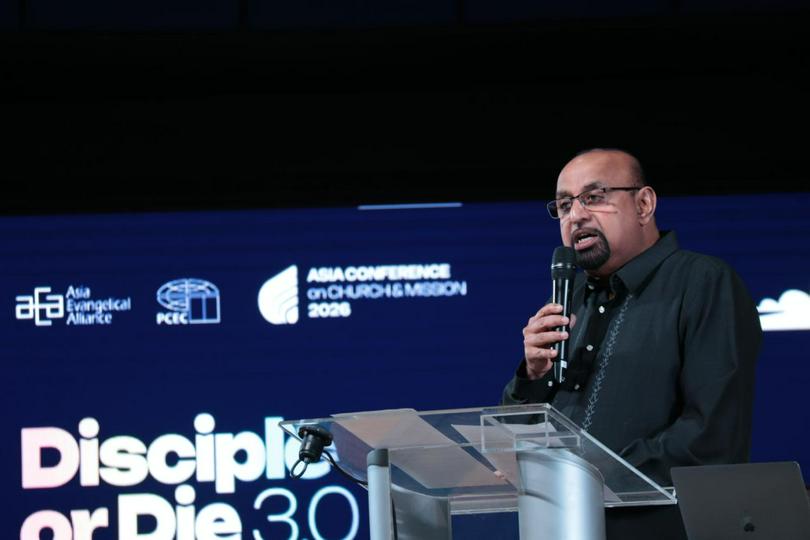
Godfrey Yogarajah chairs the International Council of the World Evangelical Alliance and the Asia Evangelical Alliance, and serves as the WEA's Ambassador for Religious Freedom. Based in Sri Lanka, he is also the chief executive officer of the country's National Christian Evangelical Alliance and its relief and development arm, Alliance Development Trust. He has long worked on religious freedom and minority rights and regularly trains Christian leaders in restricted countries on responding to persecution, advocacy, and leadership.
In this written interview, Godfrey Yogarajah discusses when churches should seek international assistance, who should decide whether to make a case public, and how advocates can support local believers without taking control of their story. He also reflects on the difficult choices churches face between resisting pressure, remaining in place, and relocating.
This interview was conducted in writing and has been edited for length and clarity.
Before addressing the questions, Yogarajah emphasized two commitments that he believes should guide any discussion of international advocacy:
Local remedies come first, and the safety of those still on the ground outweighs the visibility of any single case.
Within that framework, he said, a church or family is usually choosing among three possible postures: fight, by contesting the pressure through whatever channels remain available; flight, by relocating or seeking a way to leave; or stay, by remaining and continuing quietly. International advocacy may support any of these three choices, but it should never become a fourth option that overrides them.
China Christian Daily: When a local church faces serious pressure and domestic channels offer little protection, under what circumstances is it appropriate for the church or its family members to seek help from international churches, human rights organizations, or foreign governments?
Godfrey Yogarajah: Only when several conditions converge, not simply when one condition is present.
Domestic channels should have genuinely been tried rather than assumed in advance to be futile. Those channels may have failed, may be structurally closed, or may themselves be part of the persecution, in which case "exhausting" them is not possible in good faith.
The harm must also be serious and time-sensitive enough that waiting for the domestic process to run its course risks an irreversible loss, such as death, indefinite disappearance, a forced confession, or deportation to danger.
The affected person or family should have been consulted and should consent. International advocacy is not something done to people; it is something done with them.
There should also be a plausible reason to believe that the particular government or actor involved is sensitive to international opinion, trade relationships, or diplomatic standing. This varies enormously from one government to another. Some respond to outside pressure, while others harden in response to it.
Finally, the facts must be solid enough to withstand the government's counter-narrative, so that the case does not become a liability if important details are disputed.
If any of these conditions is missing—especially consent or a plausible theory of how international involvement could help—the honest answer is usually, "Not yet."
China Christian Daily: Who should decide whether a case is made public, and what should churches and families consider before seeking international attention?
Godfrey Yogarajah: The decision should rest with the affected person and the immediate local church leadership, not with international partners, however well-intentioned they may be.
If the person is detained or unable to communicate, the decision should fall to the family and the closest trusted local leaders who understand the particular political terrain—not to whichever international network happened to hear about the case first.
They should consider whether publicity will draw broader scrutiny onto the wider congregation. A "flagship" case can sometimes trigger a wider crackdown intended to make an example to others.
They should also consider whether the person's legal situation is still fluid enough that publicity could cut either way; whether that particular government punishes cases involving foreign attention more harshly or responds constructively to such attention; the timing of elections, diplomatic visits, or trade negotiations; and whether the harm at stake is reversible.
A pending appeal presents a different calculation from an irreversible sentence that is about to be carried out.
China Christian Daily: Some governments may regard international advocacy as evidence of foreign interference. How should churches distinguish legitimate Christian solidarity and advocacy from actual foreign control or political manipulation?
Godfrey Yogarajah: The clearest test is the origin and control of the narrative, not the mere fact of international involvement.
Legitimate solidarity is requested by the local church and remains accountable to it. It amplifies local voices rather than replacing them with outside spokespeople. It is transparent about who is funding and organizing the advocacy, and it remains focused on universally recognized rights, such as due process and freedom of conscience, rather than partisan political demands. It also stops when the local church asks it to stop.
What governments rightly—or sometimes opportunistically—describe as foreign interference tends to involve outside actors initiating a case without local consent, or funding and messaging that are tied to a foreign-policy or regime-change agenda unrelated to religious freedom. Local believers are then turned into evidence for someone else's political argument.
A useful practical discipline is to ask: If all the international partners were removed from the story, would the local church still recognize it as its own account, told in its own terms?
If not, something has gone wrong, regardless of the advocates' intentions.
China Christian Daily: Could you point to examples from Asia that illustrate both the possibilities and the risks of international advocacy?
Godfrey Yogarajah: Vietnam is a useful, though imperfect, example.
Sustained advocacy by Vietnamese Protestant house-church networks working with diaspora groups contributed to international pressure on Vietnam over religious freedom. The U.S. Commission on International Religious Freedom began recommending that Vietnam be designated a "Country of Particular Concern" in 2001, and the U.S. State Department made that designation in 2004.
The designation was connected to Vietnam's broader diplomatic and trade interests, including its effort to join the World Trade Organization and normalize relations with the United States. This gave the international pressure real leverage.
Vietnam responded with the 2004 Ordinance on Belief and Religion and its implementing decree, which created a legal registration pathway for house churches for the first time. Hundreds of Hmong Protestant congregations subsequently applied for registration.
What made the advocacy effective was not a single dramatic case. Local churches drove the narrative themselves over a period of years. The advocacy was connected to something the government actually valued—trade and diplomatic normalization—and it aimed at systemic legal change rather than the release of one person.
Implementation, however, remained uneven. Registration rosters sometimes became a tool for identifying and pressuring believers rather than protecting them, and only a small proportion of applicants were ultimately registered. Even positive international advocacy rarely produces a clean victory. Whatever gains are achieved must be defended and renewed continuously.
The case of Asia Bibi in Pakistan provides a cautionary example.
Sustained international advocacy—including petitions, papal appeals, and extensive media coverage—contributed to her acquittal by Pakistan's Supreme Court in 2018 and her eventual resettlement in Canada.
But the acquittal triggered days of violent protests across Pakistan. Christians make up only about two percent of the country's population, and churches reported tightening security and scaling back public Christmas celebrations that year because of fears of retaliation.
Two public officials who had defended Bibi had been assassinated years earlier, underscoring how combustible the case already was before its international profile reached its height.
The lesson is not that the advocacy was wrong. An innocent woman's life was at stake, and she is alive today. The lesson is that a legal system's ruling and a society's reaction to that ruling are two different battles.
Advocates need to prepare for the second as deliberately as they prepare for the first. That may involve putting security support in place for the wider community, coordinating the timing of public advocacy with local church leaders who understand conditions on the ground, and not declaring victory the moment the individual case is resolved.
China Christian Daily: How can international advocates support a local church without taking over its story, setting its political agenda, or allowing its suffering to become part of geopolitical competition?
Godfrey Yogarajah: Advocates should begin by asking what the local church wants rather than assuming what it needs. Local language and local framing should lead, rather than categories imported from a different political context.
Facts should be verified through direct and trusted local channels before they are amplified. There should also be an active two-way channel of communication so that the local church can pause or stop the campaign whenever necessary. Wherever it is safe to do so, local believers' own voices should remain at the center of the story.
There are several warning signs that public advocacy may be moving too quickly or becoming driven primarily by overseas organizations.
The pace of publicity may be outrunning what local leaders have actually agreed to. The political framing used in international coverage may not have originated with the local church. An international organization, rather than a local believer, may have become the public spokesperson. Funding or campaign decisions may be made without continuing consultation with people on the ground.
Another warning sign is when a case is folded into a wider geopolitical rivalry—such as great-power competition or a broader regime-change narrative—that has little to do with the original pastoral concern.
China Christian Daily: How should advocates balance attention to highly visible cases with the needs of less visible believers and the wider church?
Godfrey Yogarajah: Both matter, and treating them as a trade-off is itself a risk.
A "flagship prisoner" strategy can inadvertently create a two-tier system. Enormous resources and global attention may focus on one recognizable name, while ordinary believers in the same movement face similar pressure without the same protection.
In some cases, pressure on less visible members may intensify after a prominent case attracts attention, as authorities seek to make an example of those who do not have the same international profile.
Effective advocacy should therefore combine high-profile casework, when the family wants it, with sustained investment in broader goals. These may include legal reform, due-process protections, legal assistance, lawful space for churches to operate, and pastoral and practical support for less visible believers and their families.
The aim should be to raise the level of protection available to the wider community rather than concentrating all available attention and resources on a single case.
China Christian Daily: When Christians face sustained pressure, how should a church discern between remaining to bear witness locally and leaving to protect families or preserve the church community?
Godfrey Yogarajah: There is no single normative answer. Scripture itself presents both responses as legitimate.
Jesus instructed his disciples to flee to the next town when they were persecuted in one place. Paul also escaped from Damascus by being lowered from the city wall. These examples stand alongside a long Christian tradition of faithful endurance and martyrdom.
The question is not which choice is more spiritual, but which one serves the church's actual survival and witness in that particular moment.
The church should consider whether the leader's presence is irreplaceable to a fragile congregation or whether others can sustain the ministry. It should consider the immediacy and severity of the threat, and whether remaining preserves the church's witness or simply removes a leader from future service through imprisonment or death.
A pastor's willingness to suffer is not the only factor and should not be treated as though it were. Spouses and children did not choose pastoral leadership and have not consented to bear the same risk merely by association. Their voices should have a real and continuing place in the decision, rather than being heard only after the pastor has already decided.
Where children are involved, caution should carry greater weight precisely because children cannot meaningfully consent to risks taken on their behalf.
Depending on the circumstances, remaining and suffering, having the family leave while the pastor remains, and relocating together may all be legitimate choices. A pastor who survives in exile may still be able to serve the church; one who is imprisoned or killed usually cannot.
Because a leader's choice affects the entire congregation and not only the leader's household, the wider church community should also have a voice in succession planning and in determining how much risk the community is prepared to bear.